While I will admit that it's somewhat embarrassing to take four months to finish a book (The Grapes of Wrath), that in no way diminished the pride I felt the day after I turned the four hundredth and sixty something page and realized I'd reached the end. Since I started Grapes, I quit my job, moved 1000 miles, went (and still am going) through a break-up, and am working in a new field of interest, so it's been quite a tumultuous road. Needless to say, I haven't been reading every night and, for awhile there, I had to force myself to power through.
That said, the book is very well written (obviously, it's Steinbeck) and I was amazed at Steinbeck's ability to craft words in ways that, until now, I hadn't thought possible. I wish I could sit down and write something coherent about the book, but given that I read it over such a long period of time, I really don't think I can do it justice. Aside from the beautifully crafted prose and chapters of descriptive narrative, I thought that the most astonishing part was the end. It was sudden, and contradictory to what I felt the story arch should be, and yet now I look back and think that if I had been in Steinbeck's position, I don't know if I would've written the story to a conclusion either.
The vast number of migrant workers that moved from the Midwest to California during the Dust Bowl didn't become the prosperous, independent business owners they had dreamt they would be. The sudden influx of labor created an enormous surplus in a market that had, at one point, needed workers, but now had more than they knew what to do with. Wages plummetted below the standard of living and suddenly the people that had transplanted themselves in hopes of starting life anew found they were in a position much worse than before. Families broke apart in the face of unanticipated stressors: prejudice, threats of communism, police brutality, to name a few.
I guess what I'm saying is that I am starting to see why Steinbeck didn't finish out each character's trajectory. Yes, he could've written about how the family serendipitously encountered food, found work, and managed to survive, but his aim wasn't to write an uplifting novel describing an outcome that happened only for the very few. Steinbeck obviously wanted to write about what really happened. For the most part, these people were forcibly removed from the land where they had been for generations and transplanted to another part of the country where they faced the harsh reality of what had always been their situation. Yes, they had always been on the brink of poverty, but the closeness of their family and the simplicity of their lives had obscured that fact from view. With the elimination of their property, they became a transient working class with no skills other than manual labor at their disposal. Most of them became unemployed and with no work, there was no money; with no money, there was no food; with no food, most wouldn't like to extrapolate outward.
Sure, Steinbeck leaves the end up to the reader's imagination, but manipulating the story to a positive end would involve some sort of deus ex machina vehicle that is so clearly unrealistic that the end is effectively written without writing. It's striking in so many ways, it really leaves you sitting there with a hollow feeling about the whole thing. While I could wish the ending was different for the Joad family, it just, well, isn't.
Moving on, I'm getting back on the reading/writing horse. Next up is Revolutionary Road by Richard Yates. Goal is to finish it before it is in theaters (December 25). I'm actually quite excited for the movie version because it's gotten a significant amount of buzz, it is no doubt going to be Kate Winslet's sixth Oscar nomination, and the director has a fair amount of experience adapting written work to film (American Beauty).
Saturday, December 13, 2008

Saturday, September 6, 2008
In the meantime
So it's that time of (four) year. The presidential election is upon us and it's what everyone's trying to keep themselves from talking about. Even though we know it's borderline inappropriate to discuss personal political views at work, we're all doing it. I'm trying not to offend anybody in the process, but, at the same time, I feel like my doing so is unavoidable. I feel like I'm losing control to politics - it's all I can talk about, all I can think about, all that I care about? This blog is the last politics-free area of my life and I want it to stay that way. So obviously, I'm starting a separate blog on politics and current events. It will be a group venture and a learning experience at the same time. I'm quite excited about it and will link to it on my blog links once it is up and running.
In the meantime, I'm still enjoying The Grapes of Wrath and Google's new internet browser, Chrome. For more details, click here.
Wednesday, September 3, 2008
Would you like Pommes Frites with that?
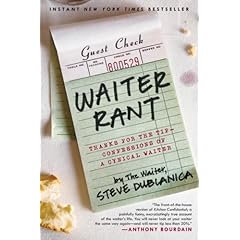
Waiter Rant by The Waiter (Steve Dublanica), Ecco 320 pages.
This weekend I only managed to finish Waiter Rant. Among other things, I had to reinstall Windows (see earlier post), treat a heat rash, and get rid of a migraine, so, needless to say, it was a busy three days. Still don't feel much like myself, but I figured I'd write up my thoughts on this book.
Waiter Rant is a brief look at a few years in the life of a New York waiter. Pseudonyms are used to protect the innocent (presumably the author himself), though Steve Dublanica has since come forward as the author of both the blog and subsequent book that has raised so many eyebrows.
I had read a bit of his material at his blog (http://www.waiterrant.net/). I enjoyed his writing, at least at the blog level, and figured I'd pick up his book. The book itself is pretty good - the writing is witty, very conversational, and I can identify with most of the horror stories from my brief stint as a server at Bertucci's Brick Oven Ristorante. His stories are assorted and funny, well-written, and I could see how it would be easy to get swept up in just telling stories. Instead, Dublanica keeps the pace well and the overall plot also has a healthy arch to it - beginning with his entry to the restaurant industry, ending with his departure.
It's an entertaining read, but like anything of this sort, it's sort of disposable. I mean, I enjoyed reading his stuff, but I guess I'm more in the mood for something a little more substantial? weighty? significant? I think it's unfair of me to criticize his piece with my whining for non-fiction. If I want non-fiction that is socially relevant, then that's what I should read. Bottom line: The book accomplishes what it sets out to do. It's entertaining, a well-written, fun, light read, and allows you to exercise your empathy for the serving staff among us.
Monday, September 1, 2008
The 1% Well-Read Challenge

I stumbled onto the 1% Well-Read Challenge and decided to give it a go. The premise is to read 10 books in 10 months (easy enough) and they have to be on the "1001 Books to Read Before you Die" list (also easy enough). The list is pretty exhaustive though some of mine aren't on there. I've joined late, so please allow me to put one that I've already read and reviewed as my first selection. Here are my ten.

Sunday, August 31, 2008
Totally Random

I read PostSecret a lot. Today's was particularly disturbing, only because I know someone who would do something like this.
More on 'American Wife'
Sorry if I'm dwelling on this title, but Sittenfeld's Prep is really a great piece of literature, even if it isn't high-minded. Her character development and realistic plotlines make for gripping stuff... even if she isn't John Grisham. Her books are page-turners in other ways, and I admire that.
Here's a link to an interview with her.
And it appears she drew the short or long straw, depending on how Kakutani feels about it. The official review is here - the one I posted yesterday was by Joyce Carol Oates and was more reflective/descriptive. I haven't read it yet, but I'm praying for Sittenfeld's soul as Kakutani can be ruthless.
Here's a link to an interview with her.
And it appears she drew the short or long straw, depending on how Kakutani feels about it. The official review is here - the one I posted yesterday was by Joyce Carol Oates and was more reflective/descriptive. I haven't read it yet, but I'm praying for Sittenfeld's soul as Kakutani can be ruthless.
Saturday, August 30, 2008
Curtis Sittenfeld, part deux
Curtis Sittenfeld, author of the great book Prep, has a new one out 'American Wife'. Here's the review. I'm not sure I'm interested in polisci chicklit, but it may be worth a read.
NYTimes 'American Wife' Review.
NYTimes 'American Wife' Review.
A Post-Trojan World.
I remember a time when I didn't have internet access. I remember a time when I didn't compulsively check my email or surf the internet. Without waxing nostalgic, I'm just going to say, boy, are those times over.
Two nights ago, my McAfee virus scan caught wiff of a virus. Ironically, I had run a scan a few days before that and there were no unusual results. This stubborn virus reared its ugly head quickly and powerfully. All of a sudden, I couldn't run any internet browsers. In the blink of an eye, I had no email. I started running multi-hour system scans. Each and every time I could detect the existence of the virus, but it couldn't be moved, deleted, or cleaned.
And it was all I could think about! The more stubborn the virus was, the later I stayed up. I'd just sit there in the dark, watching the DNC and contemplating my next move. Nothing I did worked. All the advice I researched at work was powerless against this crazy virus. And so I had no choice. After many discussions with myself and with others, I realized that the only solution would be to reinstall Windows.
I mean, this wasn't entirely unpredictable. My computer is 3 years old and has been gradually slowing down over the last several months. But I was really dreading this. Operating systems are one of those mysteriously complex pieces of software. It's not like updating iTunes, this is unchangeable stuff here.
I began my preparations. Putting my most valuable files onto my external harddrive felt a lot like packing before the gestapo raids your house: totally unsure if you have everything you need, if you're leaving anything behind, and fully knowing that everything left behind will be gone when you get back.... if you get back. I took my time looking through some of it. There were the 12 pages of memoir I wrote when I was 17 that has been moved through three computers in hopes of being continued, my senior thesis, pictures from my whole college career, and my music. The most important part I think - all $600 of iTunes glory.
So maybe I was overly emotional about the whole thing. It went fine, although I still harbor resentment against the powers that be for making me spend over 12 hours on this thing. At least it's a 3-day weekend and I staved off purchasing a multi-thousand dollar machine. I know it's only a matter of time, especially coming up on year four of abuse. I mean, this thing used to go everywhere with me throughout college: class, the theater, the dining hall, that one time I went to the library (not that I didn't study... just that the other people studying stressed me out. long story).
So I'm up and running again. Thankfully.
Two nights ago, my McAfee virus scan caught wiff of a virus. Ironically, I had run a scan a few days before that and there were no unusual results. This stubborn virus reared its ugly head quickly and powerfully. All of a sudden, I couldn't run any internet browsers. In the blink of an eye, I had no email. I started running multi-hour system scans. Each and every time I could detect the existence of the virus, but it couldn't be moved, deleted, or cleaned.
And it was all I could think about! The more stubborn the virus was, the later I stayed up. I'd just sit there in the dark, watching the DNC and contemplating my next move. Nothing I did worked. All the advice I researched at work was powerless against this crazy virus. And so I had no choice. After many discussions with myself and with others, I realized that the only solution would be to reinstall Windows.
I mean, this wasn't entirely unpredictable. My computer is 3 years old and has been gradually slowing down over the last several months. But I was really dreading this. Operating systems are one of those mysteriously complex pieces of software. It's not like updating iTunes, this is unchangeable stuff here.
I began my preparations. Putting my most valuable files onto my external harddrive felt a lot like packing before the gestapo raids your house: totally unsure if you have everything you need, if you're leaving anything behind, and fully knowing that everything left behind will be gone when you get back.... if you get back. I took my time looking through some of it. There were the 12 pages of memoir I wrote when I was 17 that has been moved through three computers in hopes of being continued, my senior thesis, pictures from my whole college career, and my music. The most important part I think - all $600 of iTunes glory.
So maybe I was overly emotional about the whole thing. It went fine, although I still harbor resentment against the powers that be for making me spend over 12 hours on this thing. At least it's a 3-day weekend and I staved off purchasing a multi-thousand dollar machine. I know it's only a matter of time, especially coming up on year four of abuse. I mean, this thing used to go everywhere with me throughout college: class, the theater, the dining hall, that one time I went to the library (not that I didn't study... just that the other people studying stressed me out. long story).
So I'm up and running again. Thankfully.
Wednesday, August 27, 2008
The Value of Experience?
Unless you've been living under a rock for the last two years, you've been hearing at least tidbits about the presidential election and, more specifically, how inexperienced Barack Obama is. I'm not here to tell you whether or not to vote for him (that's your own choice), but I just want to say that, at this point, I'm unsure experience is what the country should be looking for in a presidential candidate.
Incumbency is at an all time high -- we have a 2-term president and so many repeat congressmen that the House of Representatives is actually "where everybody knows your name." So you could say we are at the height of the era of experienced politicians in this country. And yet, we're heading in the wrong direction. And I can say that with some certainty considering that over 70% of Americans, Republicans and Democrats alike, agree with me.
You're going to hear John McCain harping on inexperience and Hillary harped on it before him. I honestly think that's because it's the only personality characteristic that they can attack. I mean, they could talk about policy and stuff, but that's boring for the American public! Apparently, no one really wants to hear about the differences in their beliefs; they just want to hear easy, small snippets about the age of an old man and the inexperience of a relatively new face in the Washington scene.
Here's my story for the night. I'm not going to draw conclusions from it, I think they are pretty obvious and my reader(s) are smart enough to figure it out on their own.
I work at a clothing retail company. We sell a lot of clothes that prominently display the name of our brand. Every week we have graphics meetings with merchandizing, design, and graphic design departments. We hang graphics of our current products on the wall. We change our minds a lot, so we tweak graphics again and again over the course of many months. We look at the same graphic a million times before it goes into production.
Being in these meetings is kind of crazy. We already know what sells and what doesn't, what colors our customers will like and which ones they won't. And of course this is learned information. When you first start, you sit in the back, you don't ask questions, you don't offer your opinion because you think you may know what our client wants, but most of the time, you don't. Experience is what gives you knowledge. Having experience validates your opinion. So the veterans discuss, and the newbies scribble down notes -- listening and watching instead of contributing to the discussion.
One Tuesday, there was a new face in the meeting. We'll call him Peter. Peter had just started at the company and he was completely overwhelmed by halfway through his second day (as we all are in the beginning). He was hanging back as the inexperienced ones do, not contributing, just watching and learning.
The discussion moved to the graphics for an item about to go into production. The graphic was in its final stages of modification. It had been reviewed over the last three and a half months, multiple times a week by many different employees. There weren't many comments on the graphic and the lead graphic designer was about to move the discussion to different artwork. "I guess we're fine with this and can move on to ---." Then Peter raised his hand. It was a timid kind of interruption. He said, "Um, guys? I think there's a mistake." And he pointed. He pointed at the graphic that everyone had been looking at, that everyone had been discussing and editing and tweaking for three and a half months.
We had misspelled our own name.
Incumbency is at an all time high -- we have a 2-term president and so many repeat congressmen that the House of Representatives is actually "where everybody knows your name." So you could say we are at the height of the era of experienced politicians in this country. And yet, we're heading in the wrong direction. And I can say that with some certainty considering that over 70% of Americans, Republicans and Democrats alike, agree with me.
You're going to hear John McCain harping on inexperience and Hillary harped on it before him. I honestly think that's because it's the only personality characteristic that they can attack. I mean, they could talk about policy and stuff, but that's boring for the American public! Apparently, no one really wants to hear about the differences in their beliefs; they just want to hear easy, small snippets about the age of an old man and the inexperience of a relatively new face in the Washington scene.
Here's my story for the night. I'm not going to draw conclusions from it, I think they are pretty obvious and my reader(s) are smart enough to figure it out on their own.
I work at a clothing retail company. We sell a lot of clothes that prominently display the name of our brand. Every week we have graphics meetings with merchandizing, design, and graphic design departments. We hang graphics of our current products on the wall. We change our minds a lot, so we tweak graphics again and again over the course of many months. We look at the same graphic a million times before it goes into production.
Being in these meetings is kind of crazy. We already know what sells and what doesn't, what colors our customers will like and which ones they won't. And of course this is learned information. When you first start, you sit in the back, you don't ask questions, you don't offer your opinion because you think you may know what our client wants, but most of the time, you don't. Experience is what gives you knowledge. Having experience validates your opinion. So the veterans discuss, and the newbies scribble down notes -- listening and watching instead of contributing to the discussion.
One Tuesday, there was a new face in the meeting. We'll call him Peter. Peter had just started at the company and he was completely overwhelmed by halfway through his second day (as we all are in the beginning). He was hanging back as the inexperienced ones do, not contributing, just watching and learning.
The discussion moved to the graphics for an item about to go into production. The graphic was in its final stages of modification. It had been reviewed over the last three and a half months, multiple times a week by many different employees. There weren't many comments on the graphic and the lead graphic designer was about to move the discussion to different artwork. "I guess we're fine with this and can move on to ---." Then Peter raised his hand. It was a timid kind of interruption. He said, "Um, guys? I think there's a mistake." And he pointed. He pointed at the graphic that everyone had been looking at, that everyone had been discussing and editing and tweaking for three and a half months.
We had misspelled our own name.
Tuesday, August 26, 2008
Steinbeck, the DNC, and waiting tables
The Grapes of Wrath is a fantastic book, but, for some reason, I just can't bring myself to get through it during the week. I've moved it to the 3-day weekend agenda and I'm sure that I'll be able to finish it with time to spare. So far, all I can say is that John Steinbeck is a good writer. Please note this is the understatement of the century. There's something so gratifying about reading a good book. It's kind of like watching the Olympics. I'm bearing witness to something I could never do, to something I couldn't even begin to tell you how to do. I have no idea how Steinbeck does what he does, but I'm glad I'm literate and can therefore enjoy it with the rest of us.
On top of that, I'm maxed out on politics with the DNC every night on top of Obamanomics. So I'm putting that aside until the convention is done. I'm working 12-hour days, so my nights need to be full of escapist reading. So what am I reading?
The answer is Waiter Rant, the story of a 30 year-old man who, through the oft unfortunate trials of life, went from a priestly aspirant to a waiter. Yup, a waiter. What once began as a transitional phase ended up as a career choice and after creating a hysterical blog, he was eventually approached with a book deal. And rightfully so, as he can write quite well and his tales from the other side of the corkscrew are both varied and well-presented. I've clicked through a bunch of his entries on Waiter Rant (the entries on the blog are isolated incidents, while the book is a more continuous narrative), and have yet to find an entry that hasn't made me snort out loud. The whole thing is non-fiction (a fact which you need to continuously repeat in the most ridiculous situations) and so far it's well-paced and definitely entertaining. I mean, part of me loves it because of my previous employment at this establishment. However, I really think it's an objectively fun read and a great way to escape your job, especially if you're going through a rough time like me.
On top of that, I'm maxed out on politics with the DNC every night on top of Obamanomics. So I'm putting that aside until the convention is done. I'm working 12-hour days, so my nights need to be full of escapist reading. So what am I reading?
The answer is Waiter Rant, the story of a 30 year-old man who, through the oft unfortunate trials of life, went from a priestly aspirant to a waiter. Yup, a waiter. What once began as a transitional phase ended up as a career choice and after creating a hysterical blog, he was eventually approached with a book deal. And rightfully so, as he can write quite well and his tales from the other side of the corkscrew are both varied and well-presented. I've clicked through a bunch of his entries on Waiter Rant (the entries on the blog are isolated incidents, while the book is a more continuous narrative), and have yet to find an entry that hasn't made me snort out loud. The whole thing is non-fiction (a fact which you need to continuously repeat in the most ridiculous situations) and so far it's well-paced and definitely entertaining. I mean, part of me loves it because of my previous employment at this establishment. However, I really think it's an objectively fun read and a great way to escape your job, especially if you're going through a rough time like me.
Saturday, August 23, 2008
Scraping the Bottom of the Motivational Barrel....
Recently, I've found it really hard to get my ass to the "Compose Post" page. I haven't been reading too much and what I had read hasn't really moved me to write on here. I've also come to an impasse in terms of readership. Checking the traffic flow, my readership has dwindled down to just me, checking in once a day (though I did get a few hits from Beijing which I chalked up to journalists testing the firewall). I credit myself for most of this decline. I haven't really been posting anything of substance and the writing has been subpar, so why would anyone visit here? So I am open to new ideas and have been reading other blogs to find out how they came about their 122-comment posts.
One blog that I came across is Waiter Rant. I discovered this at the New Non-Fiction table at B&N. Instead of purchasing on site, which is what I've been doing the past three months, I was writing down titles for goodreads/shelfari searches, so I scribbled in my day planner and kept moving. Upon googling, I found Waiter Rant, the blog that spawned the book deal and won the "Best Writing" award at the 2006 bloggies. Having been a waiter myself, I was instantly hooked by some of his posts, and, at times, laughed outloud. But what I was more interested in was how it started.
I know that my blog will never have as many readers as Waiter Rant. 75 comment posts are ridiculous. Where would I find that kind of material? I mean, yes, I work in merchandizing for a retailer. A retailer for which people would kill to know its inner-workings. If you think Anna Wintour/Vogue turned Miranda Priestly/Runway is literary gold, then you really haven't seen anything yet. For the most part, it does live up to that hype (though in ways you'd never imagine), but the problem is that I don't particularly want to get fired at this point, so the confidentiality contract is what it is. On top of that, I don't find much solace in working a 13 hr day, then coming home from my 13 hr a day job to write about my 13 hr a day job. You see?
So I was really interested to find out how Waiter Rant went from 0 comments a post to 150 comments a post in 4 years. I notice a bunch of things - forcing himself to post regularly (at which I'm a failure), linking to similar blogs, and incorporating bits of his real life into his stories (all of it is real life, but I mean non-waiter life). So first, I need to post regularly. I'm going to follow his lead and start with 3 times a week mandatory. And if I post more, that's great. As far as linking to similar blogs, I haven't found any. Apparently lots of disgruntled waiters use blogs as their therapy of choice. I can't find anyone without a stick up their ass who writes about books. I'm still looking though. Maybe I'll just post to fun blogs instead. And last, I'll try to write about my actual life without revealing too much of what I do.
So today, I have some errands, and I'm going to pick up Waiter Rant, and Eat, Shoots & Leaves (must work on my punctuation), then to the pool with me. Hope everyone is having an enjoyable close to their summer. For the most part, I am not. Work is dominating my life, I'm tired all the time (for which I blame the Olympics), but it seems that if I go to bed rather than passing out on the couch, then waking up at 3 or 4 in the morning, I am much more rested. Please excuse me now while I go listen to my Sunday talking heads.
One blog that I came across is Waiter Rant. I discovered this at the New Non-Fiction table at B&N. Instead of purchasing on site, which is what I've been doing the past three months, I was writing down titles for goodreads/shelfari searches, so I scribbled in my day planner and kept moving. Upon googling, I found Waiter Rant, the blog that spawned the book deal and won the "Best Writing" award at the 2006 bloggies. Having been a waiter myself, I was instantly hooked by some of his posts, and, at times, laughed outloud. But what I was more interested in was how it started.
I know that my blog will never have as many readers as Waiter Rant. 75 comment posts are ridiculous. Where would I find that kind of material? I mean, yes, I work in merchandizing for a retailer. A retailer for which people would kill to know its inner-workings. If you think Anna Wintour/Vogue turned Miranda Priestly/Runway is literary gold, then you really haven't seen anything yet. For the most part, it does live up to that hype (though in ways you'd never imagine), but the problem is that I don't particularly want to get fired at this point, so the confidentiality contract is what it is. On top of that, I don't find much solace in working a 13 hr day, then coming home from my 13 hr a day job to write about my 13 hr a day job. You see?
So I was really interested to find out how Waiter Rant went from 0 comments a post to 150 comments a post in 4 years. I notice a bunch of things - forcing himself to post regularly (at which I'm a failure), linking to similar blogs, and incorporating bits of his real life into his stories (all of it is real life, but I mean non-waiter life). So first, I need to post regularly. I'm going to follow his lead and start with 3 times a week mandatory. And if I post more, that's great. As far as linking to similar blogs, I haven't found any. Apparently lots of disgruntled waiters use blogs as their therapy of choice. I can't find anyone without a stick up their ass who writes about books. I'm still looking though. Maybe I'll just post to fun blogs instead. And last, I'll try to write about my actual life without revealing too much of what I do.
So today, I have some errands, and I'm going to pick up Waiter Rant, and Eat, Shoots & Leaves (must work on my punctuation), then to the pool with me. Hope everyone is having an enjoyable close to their summer. For the most part, I am not. Work is dominating my life, I'm tired all the time (for which I blame the Olympics), but it seems that if I go to bed rather than passing out on the couch, then waking up at 3 or 4 in the morning, I am much more rested. Please excuse me now while I go listen to my Sunday talking heads.
Wednesday, August 20, 2008
Summer is almost over :(
and instead of tanning, I'm stuck inside working 12 hour days. Hmm... I'm trying to remedy this and cram three months of tanning into two days this weekend. This could potentially turn out poorly. (Not-so-vague foreshadowing, here.)
Anyway, on the literary front, there was an interesting book review today in the Times about a good summer read. If you're interested The article is titled A Cynical Seer Unnerved by her Own Inner Psychic. It seemed alternative and not a bad read. As far as I'm concerned, I'm still chugging through The Grapes of Wrath (a fantastic book) and I've picked up another book in the airport during my travels, Obamanomics: How Bottom-Up Economic Prosperity Will Replace Trickle-Down Economics.
As you can probably tell, I'm gearing up for the election. One of my favorite things is to discuss with people (I'm staying away from the word "argue", though that's what it often turns into). I think it's really important to be active in voting, and even if you disagree with current policy, you have no right to complain unless you participate! To be honest, I disagree with almost everything happening in current policy today. Instead of complaining about it, I want to learn more - a stifling amount of information - and then complain about it with facts. I'm thinking this book will be mostly theoretical, which is unfortunate, but understandable. This is supposed to be an easily digestible book that the general public can enjoy without falling asleep. So I'm looking for some fresh ideas, but, aside from that, I'm not setting the bar very high. I'll let you know how that goes.
Tuesday, August 12, 2008
Who knew Summer Reading could be boring?
Work has been ridiculous - is that always my excuse? My boss has been transferred to another department, so I'm doing twice the work... or you could say I have half the time (either one will do).
In the meantime I did finish a book: Hilma Wollitzer's Summer Reading. Unfortunately, it was disappointing. I'm not linking to it, I'm not even devoting much thought or writing to it. It was 200 and some pages of vanilla. The plot was so pointless and not in the Robert Altman's The Company/Tom Perotta's Little Children kind of way. It wasn't a tastefully framed snapshot of life, though that's clearly what it tried to be. There were supposed to be revelations and I didn't feel that any were particularly momentous, though I largely attribute that to the fact that I never became invested enough in the lives of the characters to really care if someone was hiding a case of dyslexia (yes, that's the burning secret... a Hamptons bookclubber with dyslexia).
Her writing was good in terms of structure and description, but I guess part of writing is plot, so that leaves me back at my original point that this book was weak. I'm all for the artistically minimalist plot, but not when you're characters aren't particularly real and the plot is so bleh. It was neither realistic nor unrealistic, it was neither uncompelling nor compelling. Wollitzer needs to go back to the drawing board. When you're an author, I consider the drawing board to be reading. Wollitzer needs to look at what makes a magnetic character. I mean, it's not easy to construct a person out of words. I'm not dumbing down the difficulty of the task. I guess I just expected better.
So I'm moving on to some great literature. In some vast oversight in my education, I was never forced to read Steinbeck's The Grapes of Wrath. So I'm reading it now. My friends are divided. Some have responded with, "Oh, that's a great book." Others have merely grimaced. I hope that reading it by choice and at my leisure will allow me to a appreciate it more than if I was memorizing irrelevant details while dreading the inevitable multiple choice quiz of high school English class. Anyone out there ever read The Grapes of Wrath? Thoughts?
Monday, July 28, 2008
You may be wondering
where I went. Well, I'm in Colorado ... Vail, to be precise. I'm at the 2008 Vail International Dance Festival with two good friends Damian Woetzel and Heather Watts. I'm working on getting some online traction for the festival which is both easier and harder than one would imagine. It's hard because taking photos and videos is tedious when there are so many to sort through. Easy because there are so many great things to take photos of. If you're a member of Facebook, become a fan of the Vail International Dance Festival. If you're not, you can check out the festival's flickr account managed here. And here's my favorite video that I've captured (although you can simply look at the vailvalleyfoundation's youtube channel).
Tuesday, July 22, 2008
"The One You Have To Read"
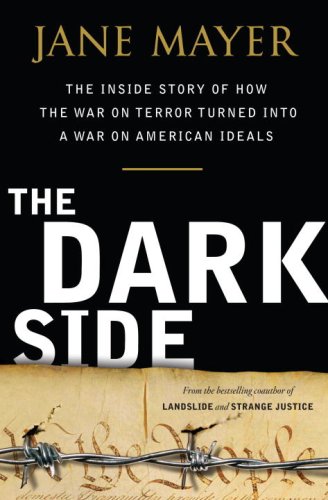
Today, The New York Times ran two articles on a new book that some have touted as the one book you have to read before the upcoming presidential election. I strongly believe in making informed decisions and better understanding the world around you, so I submit this reading choice to you.
It is called The Dark Side: The Inside Story of How the War on Terror Turned into a War on American Ideals by Jane Mayer.
From the reviews, I've gathered that it is a fantastic piece of nonfiction. Both professional critics and randoms on goodreads.com praise its exhaustive research, its fascinating subject matter, and, most importantly, its readability (since it is a book, after all). The book's scope seems to be pretty unique - it focuses on the strategic manipulation of the Constitution to achieve the goals of the war on terror.
Now, I know that not all of the people who read my blog are politically left-leaning, so there may be some visceral reactions to this post right now, so let me explain myself. This isn't an I-hate-the-Bush-administration post (because if I started one of those, I wouldn't go to sleep tonight). What I'd like to do is quickly speak (ironic, as I'm typing, but bear with me) to why I think this read is important and relevant to everyone.
I think it's a necessary skill to remove yourself from a situation, to gain perspective, to acknowledge your opinions as subjective creations from your psyche and admit to yourself that they are not truths, no matter how much you wish they were. So, aside from the fact that you may or may not believe the war on terror, as we now define it, was necessary, there are significant issues that this work discusses. Significant issues that can help us get a bit of perspective.
I don't think that moral codes are immutable. I've never met a single person of any political persuasion that has exemplified an unwavering belief system that functions all the time in any situation. And expectedly so: life is complicated and a set of black and white rules would be a surprising solution for the complexities of the real world. Case in point: the Constitution. The Constitution was our set of American ideals, our code of conduct, and, I could argue that it still is, to some extent. However, a lot of the basic tenets of universal freedom and liberty have been suspended during this extraordinary time. The Constitution is no longer so black and white.
(" But extraordinary times call for extraordinary measures.") But what defines extraordinary? When do you cross the line that separates ordinary from extraordinary? When does the administration get to decide we're no longer playing by the rules anymore? The answer really can't be "never" (as much as I'd like it to be). I think that's asking too much of mere mortals. But when did we decide to sacrifice the long term for the short term? ("Yes, we're violating the Geneva Convention, but we need to be safe today.") The country's been threatened from abroad before, some would argue, to a greater, more deadly extent. What made this time different? Was it the culture of Islam? Was it the vehicle of terror? Was it jihadists "not playing by the rules"? Was it the neoconservative, radical foreign policy views of the Bush administration? Was it a combination of the two: a sort of perfect storm?
This book is important, no matter who you are because we all have rights, specifically, rights we'd prefer remained unviolated. But sadly, rights are social constructs. We all believe in some rights. We have them; we exercise them. So this book pertains to you. When do you feel comfortable giving them up? When do you voluntarily relinquish them? If they go on hiatus, will they return just as strong as they were before? By investigating the Bush administration's interactions with constitutional law, I'm hoping this book makes me think about the answers to these not-so-hypothetical questions.
Several reviewers have commented that they have nightmares after reading this book, that they feel outraged, sick, repulsed. So you could feel this way too. Or you could stand up and cheer (if you're a sociopath). Either way, I think it's necessary information that needs consideration.
NYT review here. Bob Herbert's commentary here.
Sunday, July 20, 2008
A Busy Weekend
makes for not much reading and more than enough exhaustion. After a weekend dominated by a family wedding (OSU-themed, to be precise), and punctuated with a Saturday morning viewing of The Dark Knight, a Friday visit by the parents, a Sunday brunch at my uncle's house, and a Sunday concert, I'm pooped and about to pass out. So no reading tonight. As sad as I am to leave Bringing Home the Birkin, I've moved on to a book listed under Tonello's favorites on goodreads.com, Don't Get Too Comfortable. In a nutshell, it takes a look at the excesses of American culture. A short read, it's a well-written and well-constructed critique of some of the more ridiculous aspects of what we believe to be "normal" in our contemporary world life. I should finish it within the next few days, and then I'll have some more coherent thoughts about the work.
Now I'm off to watch my new obsession, HBO's In Treatment, which is a fantastically written and acted look at several patients in their sessions with a therapist. If you have HBO or On Demand, you should take a closer look. Seriously.
Now I'm off to watch my new obsession, HBO's In Treatment, which is a fantastically written and acted look at several patients in their sessions with a therapist. If you have HBO or On Demand, you should take a closer look. Seriously.
Friday, July 18, 2008
Bringing Home the Birkin, to Mr. Tonello
I posted the below comment to Mr. Tonello on the previous post, but figured I should share it here in case it gets lost. (On a semi-unrelated note, the Times ran a list of book summaries for other types of beach reading, available here.)
Sorry for the lack of posting! I've been suffering from internet problems, so I've been saving a few things in draft form to post later. Anyway, just wanted to let you know how thrilled I am that you liked my previous post. I loved your book in so many ways. Aside from it being entertaining, it was so succint, focused, and well-presented that, in my opinion, it seems you've mastered two of the most important aspects of storytelling: knowing where to start and knowing when to stop! It made for a really fun read.
I had skimmed the NYT review prior to buying your book, but I didn't read it that closely until afterwards. (Intentional on my part, since I didn't want what's-her-face's opinion to taint my reading experience.) And, to be honest, it really frustrated me!
The entire review, save for the last paragraph was spent either regurgitating so much of the plot that it was almost a spoiler, or discussing the history of the Birkin bag. Neither should've taken the space it did, and I would've been more interested to hear what was good about the book/what the reviewer liked, rather than a summary.
So in the final paragraph, she barely touches on a substantive review, and all she has to say is that you could have uncovered some deeper truths?? I couldn't believe it. How bizarre and ill-fitting would it have been if this adventure-comedy had turned serious social commentary in the flip of a page? I can hardly think of something more out of the scope of what you're writing about. And, on top of that, I can almost picture the review she would've written if you had included said nuggets of wisdom. ("His social commentary on high-brow consumerism seemed misplaced and poorly constructed and entirely out of place within the scope of the narrative...")
I don't think the reviewer honestly could have thought including a commentary would have made your work better. Rather, I think she was desperate to find something wrong with it, something to disagree with.
Scope is something so subjective that it's difficult to critique. I think once you get past the crucial elements that need to be included in a story, the reviewer needs to respect the discretion of the author. If an author chooses to leave out a non-critical element of the story or choses to define the breadth of the plot in a certain way, can you rightfully criticize them for doing so if all necessary components ARE included? It's a tough line to draw, but in the end, I think not.
As much as she thinks a social commentary should've been included, she should acknowledge the fact that it's not central to the aim of the book, that you chose the scope of your writing as you saw fit, and the book isn't any less great for not including it. My point? I just don't think it was worth mentioning. You define the scope, not her, so why can't she evaluate you based on what you've put forward instead of what you haven't? Sorry I got so carried away - this kind of criticism plagued me during my college years and I clearly still harbor feelings of ill will toward former TFs.
hope all is well with you and you continue writing! (are you going to? more stories?)
Bringing Home the Birkin review available for reading here.
Sorry for the lack of posting! I've been suffering from internet problems, so I've been saving a few things in draft form to post later. Anyway, just wanted to let you know how thrilled I am that you liked my previous post. I loved your book in so many ways. Aside from it being entertaining, it was so succint, focused, and well-presented that, in my opinion, it seems you've mastered two of the most important aspects of storytelling: knowing where to start and knowing when to stop! It made for a really fun read.
I had skimmed the NYT review prior to buying your book, but I didn't read it that closely until afterwards. (Intentional on my part, since I didn't want what's-her-face's opinion to taint my reading experience.) And, to be honest, it really frustrated me!
The entire review, save for the last paragraph was spent either regurgitating so much of the plot that it was almost a spoiler, or discussing the history of the Birkin bag. Neither should've taken the space it did, and I would've been more interested to hear what was good about the book/what the reviewer liked, rather than a summary.
So in the final paragraph, she barely touches on a substantive review, and all she has to say is that you could have uncovered some deeper truths?? I couldn't believe it. How bizarre and ill-fitting would it have been if this adventure-comedy had turned serious social commentary in the flip of a page? I can hardly think of something more out of the scope of what you're writing about. And, on top of that, I can almost picture the review she would've written if you had included said nuggets of wisdom. ("His social commentary on high-brow consumerism seemed misplaced and poorly constructed and entirely out of place within the scope of the narrative...")
I don't think the reviewer honestly could have thought including a commentary would have made your work better. Rather, I think she was desperate to find something wrong with it, something to disagree with.
Scope is something so subjective that it's difficult to critique. I think once you get past the crucial elements that need to be included in a story, the reviewer needs to respect the discretion of the author. If an author chooses to leave out a non-critical element of the story or choses to define the breadth of the plot in a certain way, can you rightfully criticize them for doing so if all necessary components ARE included? It's a tough line to draw, but in the end, I think not.
As much as she thinks a social commentary should've been included, she should acknowledge the fact that it's not central to the aim of the book, that you chose the scope of your writing as you saw fit, and the book isn't any less great for not including it. My point? I just don't think it was worth mentioning. You define the scope, not her, so why can't she evaluate you based on what you've put forward instead of what you haven't? Sorry I got so carried away - this kind of criticism plagued me during my college years and I clearly still harbor feelings of ill will toward former TFs.
hope all is well with you and you continue writing! (are you going to? more stories?)
Bringing Home the Birkin review available for reading here.
Monday, July 14, 2008
Bringing Home the Birkin, a Wrap-up
So I've finished Bringing Home the Birkin. I spent the rest of Sunday grocery shopping, came home after a short bout at the office, nestled in with some spicy tuna rolls, watched The Breakfast Club, and now I'm writing this post with Viva La Vida on, the windows open, and a fresh breeze circulating. There's something about summer weekends right before they become oppressively hot that is quite perfect. Winter just doesn't compare.
To be honest, I think part of my good mood has to do with this book. Bringing Home the Birkin is a great read, of the summer persuasion or otherwise. I'm going to try to explain what Michael Tonello gets right without giving away too much of the good stuff.
The story begins with him moving to Barcelona after growing tired with Massachusetts. (I can identify with this. Only I moved to Ohio, which is different.) When his job falls through, he's left with a 5 year lease, no Spanish skills, and no work visa. Quite frankly, this is where my story would have taken a turn towards me rocking back and forth in the fetal position, but this man is an opportunist. After a few successful auctions on Ebay, he stumbles upon an Hermes underworld of sorts where thousands of scarf and handbag collectors are constantly on the prowl for rare and vintage Hermes merch. That's about the first 50 pages.
The rest of the book entails how he starts amassing knowledge about the Hermes brand, navigating the world of ecommerce, discovering the "code" that secures him Birkins (that are known for their exclusivity and 2 year waitlist - only he can score them in 30 minutes), and the chaos that invariably comes with moving upwards of a million dollars of merchandise in a single year.
You don't need to know much about Hermes or designer labels to appreciate the story. The fact that Tonello starts out relatively green on the subject allows the audience to learn along with him. There's a healthy amount of romance, which is always appreciated, as well as a good dose of drama (which seems par for the course in the world of retail, luxury or otherwise).
There are a few things that made the story great. First, and probably most importantly, his writing is effortless. So often writing and plot don't match. I sometimes picture romance novelists (read: the ones whose book covers are adorned with naked torsos) writing with their reading glasses down their noses, crafting their words with such flourish that they seem to have convinced themselves that they are writing the next great American novel. They completely miss the point of their book and, as such, their novels tend to be awkwardly executed. Tonello doesn't suffer from this problem at all. In his Amazon.com mini-interview, he says that after responding to the dreaded "So, what do you do?" question, people suggested he write a book. So he did. And that's what it feels like. It feels like I've met a quirky, vibrant guy at a sidewalk cafe who has a ridiculously unique occupation, great fashion sense, and he's giving me "the long story," only it doesn't feel long, and it's shared over a bottle of red.
Second, it's not formulaic. As I wrote last night, I would wager that it's really difficult to encounter a formulaic memoir. People with formulaic lives often don't feel compelled to write about them. So the fact that he's even bothering to put pen to paper somewhat confirms he has a unique story to tell (which he does). So the non-fiction genre benefits him amazingly well. This, coupled with his writing style, doesn't make for much fluff. Every page matters, and every sentence contributes in a meaningful way. In my view, this is the best way to measure clarity. If I could rip out whole pages without losing much substance, there's a problem. With this book, I wish I could add pages, not lose them. Which brings me to my third point...
Scope. Tonello chooses the breadth of his story perfectly. It's apparent that this is one specific and admittedly bizarre period in his life and he chooses exactly where to start and end. The New York Times critic Christine Mulke commented that she was only disappointed that Tonello didn't draw any earth-shattering conclusions from his experience:
... and I think that's a little ridiculous. It would've been completely ill-fitting for Tonello to interject a social commentary on people's deep need to fill themselves with the superficial comfort of material goods. I mean, come on, that's a little much. To start off, it doesn't fit with his personality - he's too polite to go there. Many of Tonello's customers remain behind a veil of anonymity, and I think that sweeping judgments of his clientele (of whom he knows little about, aside from their handbag and scarf preferences) is not his objective, nor should it be. He's not out to make an example of anyone.
Yet if you're really looking for a commentary, it's already there. No, Tonello, doesn't spell it out for you. But he gives the reader the tools to make a few summations of their own. He depicts most characters (save a few) in a favorable light and not one of his customers is particularly greedy, yet there's still a disconcerting insatiability to their appetite for Hermes. (This isn't about getting just one handbag, folks.) And while they have wishlists of particular merchandise, you realize that these lists are never-ending. Once one wish is fulfilled, another quickly moves to the front to replace it. I won't continue on about what I surmised about luxury culture, but I think it's fair to say that you can aptly draw your own conclusions from the material Tonello provides. (Please note that I am in no way exempting myself. The amount I've spent on bags, clothes, and shoes is, at times, shameful.)
As a whole, this book is great (5-of-5-stars great). Here's how I know:
1. I laughed out-loud. Rare for me. And when I wasn't laughing, I was smiling. And when I wasn't smiling, I was frowning because I couldn't turn the pages fast enough.
2. Pictures have long been lost in "serious literature." I think they should make a valiant return, and this book has some. Some good ones, that is.
3. I want to move to Barcelona, eat paella, and drink Sangria. Maybe out of a Birkin.
4. Perhaps the most obvious evidence of this book's greatness? At the end I was left feeling bittersweet. Bitter because it was over. Sweet because someone new to the writing business told me a great story. To continue the sidewalk cafe chat analogy, I never wondered when he'd shut up, when we could get out of the glaring sun, or when the waiter would be back to refill my glass of wine.
Cheers, Mr. Tonello. That was a damn fine book.
To be honest, I think part of my good mood has to do with this book. Bringing Home the Birkin is a great read, of the summer persuasion or otherwise. I'm going to try to explain what Michael Tonello gets right without giving away too much of the good stuff.
The story begins with him moving to Barcelona after growing tired with Massachusetts. (I can identify with this. Only I moved to Ohio, which is different.) When his job falls through, he's left with a 5 year lease, no Spanish skills, and no work visa. Quite frankly, this is where my story would have taken a turn towards me rocking back and forth in the fetal position, but this man is an opportunist. After a few successful auctions on Ebay, he stumbles upon an Hermes underworld of sorts where thousands of scarf and handbag collectors are constantly on the prowl for rare and vintage Hermes merch. That's about the first 50 pages.
The rest of the book entails how he starts amassing knowledge about the Hermes brand, navigating the world of ecommerce, discovering the "code" that secures him Birkins (that are known for their exclusivity and 2 year waitlist - only he can score them in 30 minutes), and the chaos that invariably comes with moving upwards of a million dollars of merchandise in a single year.
You don't need to know much about Hermes or designer labels to appreciate the story. The fact that Tonello starts out relatively green on the subject allows the audience to learn along with him. There's a healthy amount of romance, which is always appreciated, as well as a good dose of drama (which seems par for the course in the world of retail, luxury or otherwise).
There are a few things that made the story great. First, and probably most importantly, his writing is effortless. So often writing and plot don't match. I sometimes picture romance novelists (read: the ones whose book covers are adorned with naked torsos) writing with their reading glasses down their noses, crafting their words with such flourish that they seem to have convinced themselves that they are writing the next great American novel. They completely miss the point of their book and, as such, their novels tend to be awkwardly executed. Tonello doesn't suffer from this problem at all. In his Amazon.com mini-interview, he says that after responding to the dreaded "So, what do you do?" question, people suggested he write a book. So he did. And that's what it feels like. It feels like I've met a quirky, vibrant guy at a sidewalk cafe who has a ridiculously unique occupation, great fashion sense, and he's giving me "the long story," only it doesn't feel long, and it's shared over a bottle of red.
Second, it's not formulaic. As I wrote last night, I would wager that it's really difficult to encounter a formulaic memoir. People with formulaic lives often don't feel compelled to write about them. So the fact that he's even bothering to put pen to paper somewhat confirms he has a unique story to tell (which he does). So the non-fiction genre benefits him amazingly well. This, coupled with his writing style, doesn't make for much fluff. Every page matters, and every sentence contributes in a meaningful way. In my view, this is the best way to measure clarity. If I could rip out whole pages without losing much substance, there's a problem. With this book, I wish I could add pages, not lose them. Which brings me to my third point...
Scope. Tonello chooses the breadth of his story perfectly. It's apparent that this is one specific and admittedly bizarre period in his life and he chooses exactly where to start and end. The New York Times critic Christine Mulke commented that she was only disappointed that Tonello didn't draw any earth-shattering conclusions from his experience:
"If he’d tucked into what really makes people define themselves by their obsession to Hermès, 'Bringing Home the Birkin' could have brought home some very important truths about our times."
... and I think that's a little ridiculous. It would've been completely ill-fitting for Tonello to interject a social commentary on people's deep need to fill themselves with the superficial comfort of material goods. I mean, come on, that's a little much. To start off, it doesn't fit with his personality - he's too polite to go there. Many of Tonello's customers remain behind a veil of anonymity, and I think that sweeping judgments of his clientele (of whom he knows little about, aside from their handbag and scarf preferences) is not his objective, nor should it be. He's not out to make an example of anyone.
Yet if you're really looking for a commentary, it's already there. No, Tonello, doesn't spell it out for you. But he gives the reader the tools to make a few summations of their own. He depicts most characters (save a few) in a favorable light and not one of his customers is particularly greedy, yet there's still a disconcerting insatiability to their appetite for Hermes. (This isn't about getting just one handbag, folks.) And while they have wishlists of particular merchandise, you realize that these lists are never-ending. Once one wish is fulfilled, another quickly moves to the front to replace it. I won't continue on about what I surmised about luxury culture, but I think it's fair to say that you can aptly draw your own conclusions from the material Tonello provides. (Please note that I am in no way exempting myself. The amount I've spent on bags, clothes, and shoes is, at times, shameful.)
As a whole, this book is great (5-of-5-stars great). Here's how I know:
1. I laughed out-loud. Rare for me. And when I wasn't laughing, I was smiling. And when I wasn't smiling, I was frowning because I couldn't turn the pages fast enough.
2. Pictures have long been lost in "serious literature." I think they should make a valiant return, and this book has some. Some good ones, that is.
3. I want to move to Barcelona, eat paella, and drink Sangria. Maybe out of a Birkin.
4. Perhaps the most obvious evidence of this book's greatness? At the end I was left feeling bittersweet. Bitter because it was over. Sweet because someone new to the writing business told me a great story. To continue the sidewalk cafe chat analogy, I never wondered when he'd shut up, when we could get out of the glaring sun, or when the waiter would be back to refill my glass of wine.
Cheers, Mr. Tonello. That was a damn fine book.
Sunday, July 13, 2008
A few realizations
1) When I said I would be live blogging, apparently I took that too literally. As such, my first "live blogging" attempt became more of a "my posts are going to degenerate into poorly-written, rambling messes." Hence, my random musings on Chuck Klosterman's book. I will do better. No more of this stream of consciousness crap - I'm rereading these things before I post.
2) The internet is amazing! Michael Tonello and Sarah Strohmeyer both commented on my last post and I really had almost forgotten that the internet is accessible to people (other than me and my friends who read this to make sure I haven't slipped into the vast wasteland of anonymity that is Ohio). On a side note: must make sure to pick up Strohmeyer's book next time I'm at B&N.
3) I'm halfway through Bringing Home the Birkin. I'll save the in-depth discussion for tomorrow, but I'm loving it. The pages fly by and not in a way that feels... disposable. Most of the time, it seems that the chicklit genre is marked by a general lack of substance. I zip through the chapters and pages not because there's fast-paced action, but because the story is so formulaic that I'm salivating for what I know is going to happen eventually. What helps Birkin most is that it really isn't chicklit. I mean yes, it is a perfect beach read (it's fun to read and doesn't take itself too seriously), but it's a memoir. It's autobiographical (if you're going to the bookstore, you'll probably find it in the non-fiction/biography/autobiography section if it isn't featured on a Summer Reading table), so it pretty much avoids the main pitfall of chicklit. It is rare to find a person with a formulaic life. It's probably even rarer to find a person with a formulaic life that feels compelled to write a memoir. So the fact that this is a memoir detailing a unique experience makes Tonello immune to predictable plots, characters, and the hazardous cliches that really can kill a good story.
More tomorrow...
2) The internet is amazing! Michael Tonello and Sarah Strohmeyer both commented on my last post and I really had almost forgotten that the internet is accessible to people (other than me and my friends who read this to make sure I haven't slipped into the vast wasteland of anonymity that is Ohio). On a side note: must make sure to pick up Strohmeyer's book next time I'm at B&N.
3) I'm halfway through Bringing Home the Birkin. I'll save the in-depth discussion for tomorrow, but I'm loving it. The pages fly by and not in a way that feels... disposable. Most of the time, it seems that the chicklit genre is marked by a general lack of substance. I zip through the chapters and pages not because there's fast-paced action, but because the story is so formulaic that I'm salivating for what I know is going to happen eventually. What helps Birkin most is that it really isn't chicklit. I mean yes, it is a perfect beach read (it's fun to read and doesn't take itself too seriously), but it's a memoir. It's autobiographical (if you're going to the bookstore, you'll probably find it in the non-fiction/biography/autobiography section if it isn't featured on a Summer Reading table), so it pretty much avoids the main pitfall of chicklit. It is rare to find a person with a formulaic life. It's probably even rarer to find a person with a formulaic life that feels compelled to write a memoir. So the fact that this is a memoir detailing a unique experience makes Tonello immune to predictable plots, characters, and the hazardous cliches that really can kill a good story.
More tomorrow...
Saturday, July 12, 2008
It's about time...
the New York Times acknowledged the summer's best (or at least most hotly anticipated) chicklit novels for the year. They ran this feature article in their "BOOKS" section yesterday and I paste it here for your enjoyment.
On a Beach, Under a Tiffany-Blue Sky
Here's the list (with excerpts to boot!).
BRINGING HOME THE BIRKIN: MY LIFE IN HOT PURSUIT OF THE WORLD’S MOST COVETED HANDBAG by Michael Tonello (William Morrow); 257 pages; $25.95. purchased and reading this weekend (read: my parents are visiting next weekend and I'll clearly be handing it to mom for her to enjoy as well...)
CHASING HARRY WINSTON by Lauren Weisberger (Simon & Schuster); 280 pages; $25.95. (Excerpt) DONE
LOVE THE ONE YOU’RE WITH by Emily Giffin (St. Martin’s Press); 342 pages; $24.95. DONE
Most prominently featured in the article is Bringing Home the Birkin. Which is what I'm reading for the weekend. Here's a link of it's author Michael Tonello talking about this book and a typical day in the life of a Birkin hunter.
Side note: I've friended him on goodreads.com (facebook for book lovers). And I've already picked up one of the books that he highly recommends. Don't Get Too Comfortable: The Indignities of Coach Class, the Torments of Low Thread Count, the Never-Ending Quest for Artisanal Olive Oil, and Other First World Problems. But for now, it's all about the Birkin.
On a Beach, Under a Tiffany-Blue Sky
Here's the list (with excerpts to boot!).
AN ABSOLUTE SCANDAL by Penny Vincenzi (Doubleday); 575 pages; $24.95. (Excerpt)
ALL WE EVER WANTED WAS EVERYTHING
THE BEACH HOUSE by Jane Green (Viking); 341 pages; $24.95.
BRINGING HOME THE BIRKIN: MY LIFE IN HOT PURSUIT OF THE WORLD’S MOST COVETED HANDBAG by Michael Tonello (William Morrow); 257 pages; $25.95. purchased and reading this weekend (read: my parents are visiting next weekend and I'll clearly be handing it to mom for her to enjoy as well...)
CHASING HARRY WINSTON by Lauren Weisberger (Simon & Schuster); 280 pages; $25.95. (Excerpt) DONE
THE DAY I ATE WHATEVER I WANTED: AND OTHER SMALL ACTS OF LIBERATION by Elizabeth Berg (Random House); 242 pages; $23. (Excerpt)
LOVE THE ONE YOU’RE WITH by Emily Giffin (St. Martin’s Press); 342 pages; $24.95. DONE
SUNDAYS AT TIFFANY’S by James Patterson and Gabrielle Charbonnet (Little, Brown and Company); 309 pages; $24.99. (Excerpt)
SWEET LOVE by Sarah Strohmeyer (Dutton); 302 pages; $24.95. (Excerpt)
TROPHIES by Heather Thomas (William Morrow); 511 pages; $24.95. (Excerpt)
I'm going on a 10 day vacation in two weeks, and all of the above will clearly be necessary.Most prominently featured in the article is Bringing Home the Birkin. Which is what I'm reading for the weekend. Here's a link of it's author Michael Tonello talking about this book and a typical day in the life of a Birkin hunter.
Side note: I've friended him on goodreads.com (facebook for book lovers). And I've already picked up one of the books that he highly recommends. Don't Get Too Comfortable: The Indignities of Coach Class, the Torments of Low Thread Count, the Never-Ending Quest for Artisanal Olive Oil, and Other First World Problems. But for now, it's all about the Birkin.
Live Blogging,Commence.
So here marks my first day of semi-continuous blogging. I had to give myself a pass this week because my boss left town and I worked 67 hours. Yes, it was pretty horrible. I suppose it could've been worse. I could've noticed the minutes ticking by, but instead, I thought it was 5:30 when it was actually 8pm. I swore to myself that my reward would be sleeping in, but I woke up at 7, struggled back to bed, and woke up for real at 9:30. So much for real sleep.
Anyway, a few things. In the past week, I finished Sex, Drugs, and Cocoa Puffs by Chuck Klosterman. God knows this book is alternatively trendy - any book that's for sale at Urban Outfitters is probably not on the best seller list, but is read by self-proclaimed yuppies everywhere. Anyway, I claim ignorance. I didn't know it was sold there until after I bought the book. I managed to buck up, power through, and it ended up being an alright read.
The book's general premise is to analyze pop culture and draw earth-shattering philosophical conclusions about life. And I thought that I knew a lot about pop culture so I presumed I'd "get it." I was wrong. My definition of pop culture entails current popular culture -- but this wasn't the case for Klosterman. His writing is pretty good. The first few chapters I "got," and this book largely hinges on you already knowing (at a fairly high level) what he's talking about. This brings about a tricky hit or miss situation.
When I was in college, I took a class called Wit and Humor. A lot of people thought it was a joke (no pun intended) and therefore ended up getting some unfortunate grades. However I've never thought humor was something to laugh at (pun intended). I've always enjoyed wondering about why people laugh at certain things and not at others, so I wholeheartedly embraced what most would consider the drier points of the class. Not only did we read humor, but we studied humor theory. And we learned that one of the principal reasons people laugh at jokes is to demonstrate they are in "the know". If a joke is selective and only funny to those with a certain understanding of a topic, your "in-group" status is represented solely by you showing you get the joke, so you laugh. Hard.
This is basically the entire premise upon which Klosterman's book operates. I can imagine him sitting there writing it, thinking "oh, they so know what I'm talking about". The good news is I think he's successful. The bad news is I only think he's successful.
The first few chapters I "got." MTV's The Real World is something I've watched since I was 13 years old and Stephen slapped Irene. (If you "get" that , you're probably laughing right now.) I've seen a little from almost all other seasons - of course San Francisco (Pedro dies and Puck's an asshole.), London (Neil gets his tongue bitten off), Hawaii (Ruthie is an alcoholic - I'm not so sure now after seeing countless girls do the same as her in college), Chicago (wow, Tonya), Las Vegas... I could keep listing, but let's just say that my knowledge of some seasons of this show is borderline exhaustive. So when Klosterman starts off his Real World chapter with his friend complaining that the show isn't what it used to be (I agree), his countless references to people that might seem obscure actually make complete sense to me, so I was smiling and laughing outloud at my desk (during lunch, thank you).
He also takes some (well-deserved) potshots at Coldplay and John Cusack. Some stories about Jeffrey Dahmer were also understandable and midly amusing (not that serial killers are funny, but his summations are unique). Born-again Christianity was also an comprehensible chapter, as was his dissection of Saved by the Bell. But there were two chapters that were the longest, most in-depth analyses of Billy Joel and the Lakers/Celtics rivalry, and I didn't know enough about them to enjoy them. I seriously stalled out which seldom happens these days and, at points, I just wanted the book to end. Talk about something I know about. I guess the majority of America does know a lot about these two topics, but I don't. And it made me sad. So yeah, the book was alright. Maybe if I was a little more mainstream I could've "got" it. Is it ironic that I'm too alternative to understand a book sold at Urban Outfitters? I think so.
Anyway, a few things. In the past week, I finished Sex, Drugs, and Cocoa Puffs by Chuck Klosterman. God knows this book is alternatively trendy - any book that's for sale at Urban Outfitters is probably not on the best seller list, but is read by self-proclaimed yuppies everywhere. Anyway, I claim ignorance. I didn't know it was sold there until after I bought the book. I managed to buck up, power through, and it ended up being an alright read.
The book's general premise is to analyze pop culture and draw earth-shattering philosophical conclusions about life. And I thought that I knew a lot about pop culture so I presumed I'd "get it." I was wrong. My definition of pop culture entails current popular culture -- but this wasn't the case for Klosterman. His writing is pretty good. The first few chapters I "got," and this book largely hinges on you already knowing (at a fairly high level) what he's talking about. This brings about a tricky hit or miss situation.
When I was in college, I took a class called Wit and Humor. A lot of people thought it was a joke (no pun intended) and therefore ended up getting some unfortunate grades. However I've never thought humor was something to laugh at (pun intended). I've always enjoyed wondering about why people laugh at certain things and not at others, so I wholeheartedly embraced what most would consider the drier points of the class. Not only did we read humor, but we studied humor theory. And we learned that one of the principal reasons people laugh at jokes is to demonstrate they are in "the know". If a joke is selective and only funny to those with a certain understanding of a topic, your "in-group" status is represented solely by you showing you get the joke, so you laugh. Hard.
This is basically the entire premise upon which Klosterman's book operates. I can imagine him sitting there writing it, thinking "oh, they so know what I'm talking about". The good news is I think he's successful. The bad news is I only think he's successful.
The first few chapters I "got." MTV's The Real World is something I've watched since I was 13 years old and Stephen slapped Irene. (If you "get" that , you're probably laughing right now.) I've seen a little from almost all other seasons - of course San Francisco (Pedro dies and Puck's an asshole.), London (Neil gets his tongue bitten off), Hawaii (Ruthie is an alcoholic - I'm not so sure now after seeing countless girls do the same as her in college), Chicago (wow, Tonya), Las Vegas... I could keep listing, but let's just say that my knowledge of some seasons of this show is borderline exhaustive. So when Klosterman starts off his Real World chapter with his friend complaining that the show isn't what it used to be (I agree), his countless references to people that might seem obscure actually make complete sense to me, so I was smiling and laughing outloud at my desk (during lunch, thank you).
He also takes some (well-deserved) potshots at Coldplay and John Cusack. Some stories about Jeffrey Dahmer were also understandable and midly amusing (not that serial killers are funny, but his summations are unique). Born-again Christianity was also an comprehensible chapter, as was his dissection of Saved by the Bell. But there were two chapters that were the longest, most in-depth analyses of Billy Joel and the Lakers/Celtics rivalry, and I didn't know enough about them to enjoy them. I seriously stalled out which seldom happens these days and, at points, I just wanted the book to end. Talk about something I know about. I guess the majority of America does know a lot about these two topics, but I don't. And it made me sad. So yeah, the book was alright. Maybe if I was a little more mainstream I could've "got" it. Is it ironic that I'm too alternative to understand a book sold at Urban Outfitters? I think so.
Friday, July 4, 2008
A New Solution...
to my complete and total inability to blog is to move closer to live blogging. So once a day, I'll say at least something if I'm reading. This should fix my current problem of rare updates.
So I've actually finished an entire book without blogging about it (shame on me). Title is The Working Poor by David K. Shipler. And I'll gladly admit I was attracted to it because it had "National Bestseller" on the cover. Now, I don't normally use this tactic for fiction, because that often leads you to purchase crap that everyone can read (i.e. chicklit, The Da Vinci Code, Harry Potter, etc.), and, while that's great and all, it's not particularly good writing. So venturing off the bestseller table for fiction is safe. Venturing away from non-fiction bestsellers is iffy at best. Most of the time the reason a non-fiction book is a best seller is not because it's poorly written, but because it's so well-written that people with a normal attention span can both read and understand it and not want to kill themselves from sheer ennui. Non-best selling non-fiction is often poison and makes you want to poke your eyes out. And I would know - I read it for the last four years.
Anyway, Shipler's book is different. He tackles the problems of the working poor by doing in-depth interviews with a few people over many years. He breaks the problems of the poor into a several interlocking parts, but each chapter is someone's story that magnifies one particular part of the problem. Unfortunately, there is no person who isn't a victim of multiple problems - that is one of the main points of his book. We can't just have better health care, we also need better education, job training, parent training, etc. to fix this huge problem. Such a complicated problem necessitates a complicated solution, so, in a lot of ways, most approaches have gone about helping people the wrong way. Yes, HeadStart is helpful, but it doesn't cure rampant sexual abuse, poor healthcare, bad parenting skills, or lack of job training. A multifaceted solution is needed for a multi-faceted problem.
Shipler's book could easily be depressing, that all the interconnecting problems pose a completely impossible situation with no hope of remedy. Instead, he actually shows glimpses of success in a variety of his case studies. And he's not overly sympathetic. He acknowledges that a lot of his subjects' situations exist because of their own mistakes, but that those mistakes are often rooted in self-perpetuating cycles and a general inability to see beyond the immediate future. I don't want to give much away, but it's a great read - go buy it if you want to read something that changes how you think.
So I've actually finished an entire book without blogging about it (shame on me). Title is The Working Poor by David K. Shipler. And I'll gladly admit I was attracted to it because it had "National Bestseller" on the cover. Now, I don't normally use this tactic for fiction, because that often leads you to purchase crap that everyone can read (i.e. chicklit, The Da Vinci Code, Harry Potter, etc.), and, while that's great and all, it's not particularly good writing. So venturing off the bestseller table for fiction is safe. Venturing away from non-fiction bestsellers is iffy at best. Most of the time the reason a non-fiction book is a best seller is not because it's poorly written, but because it's so well-written that people with a normal attention span can both read and understand it and not want to kill themselves from sheer ennui. Non-best selling non-fiction is often poison and makes you want to poke your eyes out. And I would know - I read it for the last four years.
Anyway, Shipler's book is different. He tackles the problems of the working poor by doing in-depth interviews with a few people over many years. He breaks the problems of the poor into a several interlocking parts, but each chapter is someone's story that magnifies one particular part of the problem. Unfortunately, there is no person who isn't a victim of multiple problems - that is one of the main points of his book. We can't just have better health care, we also need better education, job training, parent training, etc. to fix this huge problem. Such a complicated problem necessitates a complicated solution, so, in a lot of ways, most approaches have gone about helping people the wrong way. Yes, HeadStart is helpful, but it doesn't cure rampant sexual abuse, poor healthcare, bad parenting skills, or lack of job training. A multifaceted solution is needed for a multi-faceted problem.
Shipler's book could easily be depressing, that all the interconnecting problems pose a completely impossible situation with no hope of remedy. Instead, he actually shows glimpses of success in a variety of his case studies. And he's not overly sympathetic. He acknowledges that a lot of his subjects' situations exist because of their own mistakes, but that those mistakes are often rooted in self-perpetuating cycles and a general inability to see beyond the immediate future. I don't want to give much away, but it's a great read - go buy it if you want to read something that changes how you think.
Sunday, June 22, 2008
So maybe I lied
about going AWOL for awhile. This is a work in progress. After I finished The Virgin Suicides I was a concerned about what to read next. Taking a look back on that book, it's now one of my favorite books. It was so well written, interesting, just the right length, creative. I really can't put it into words, but if you want a good book, go buy it. I hear the movie is also good. I might go check it out.
So since then, I've drifted from one book to the next. I've started to try to check myself into the presidential election. For those of you who know me, you know that I'm not just tuning in now because of political apathy.... it's more the opposite - I tend to become too involved. In 2000, I was 16 and, perhaps naively, believed certain things were untouchable (checks and balances being one of them). And I'm not saying this from a dark, angry, liberal place in my heart; I think both conservatives and liberals alike can say that Bush v. Gore was an unprecedented (and apparently never-to-be-repeated) role for the Supreme Court.
Needless to say, I took Bush v. Gore a little hard. I made a decision to remove myself from politics (2004 was a painful blip on the radar) and focused more on political theory for the next eight years. Contrary to popular belief, theory and politics are pretty closely interconnected. I need theory for me to figure out what I think the appropriate role of government and policy should be, and then politics can be used to determine the best way to achieve that goal.
After 2000, I thought I didn't want anything to do with politics, that I'd just be satisfied living in the political theory realm, so that's mostly what I studied. Hobbes, Aristotle, Plato, Locke, Mill, Madison, Jefferson, and more all helped me form some idea of what I thought a government should do for its citizens. And, for the most part, I was happy. And then things started happening. In a nutshell, our political reality started to starkly contrast with what I thought our goals as a country should be. In layman's words? The last eight years have made us stray so far from what I think the right path should be that I can't, in good conscience, continue to focus on theory.
So I'm kicking into high gear because I don't do anything half-assed. I think our public education system needs a good look, I think the welfare system and the situation of the poor in this country needs a good look, I think our role in the international economy and how we protect or don't protect our domestic industries needs a good look. So I'm trying to learn world history, sociology, anything and everything to make me think about what issues are important to me and what I want to do about them.
(Please note that while I say I didn't want anything to do with politics, I still voted in elections, so don't worry. I'm not one of those twenty-somethings.)
So since then, I've drifted from one book to the next. I've started to try to check myself into the presidential election. For those of you who know me, you know that I'm not just tuning in now because of political apathy.... it's more the opposite - I tend to become too involved. In 2000, I was 16 and, perhaps naively, believed certain things were untouchable (checks and balances being one of them). And I'm not saying this from a dark, angry, liberal place in my heart; I think both conservatives and liberals alike can say that Bush v. Gore was an unprecedented (and apparently never-to-be-repeated) role for the Supreme Court.
Needless to say, I took Bush v. Gore a little hard. I made a decision to remove myself from politics (2004 was a painful blip on the radar) and focused more on political theory for the next eight years. Contrary to popular belief, theory and politics are pretty closely interconnected. I need theory for me to figure out what I think the appropriate role of government and policy should be, and then politics can be used to determine the best way to achieve that goal.
After 2000, I thought I didn't want anything to do with politics, that I'd just be satisfied living in the political theory realm, so that's mostly what I studied. Hobbes, Aristotle, Plato, Locke, Mill, Madison, Jefferson, and more all helped me form some idea of what I thought a government should do for its citizens. And, for the most part, I was happy. And then things started happening. In a nutshell, our political reality started to starkly contrast with what I thought our goals as a country should be. In layman's words? The last eight years have made us stray so far from what I think the right path should be that I can't, in good conscience, continue to focus on theory.
So I'm kicking into high gear because I don't do anything half-assed. I think our public education system needs a good look, I think the welfare system and the situation of the poor in this country needs a good look, I think our role in the international economy and how we protect or don't protect our domestic industries needs a good look. So I'm trying to learn world history, sociology, anything and everything to make me think about what issues are important to me and what I want to do about them.
(Please note that while I say I didn't want anything to do with politics, I still voted in elections, so don't worry. I'm not one of those twenty-somethings.)
Sunday, June 8, 2008
On the morning the last Lisbon daughter took her turn at suicide
-- it was Mary this time, and sleeping pills, like Therese -- the two paramedics arrived at the house knowing exactly where the knife drawer was, and the gas oven, and the beam in the basement from which it was possible to tie a rope.
That's the very first sentence of Eugenides's The Virgin Suicides. I've only finished a chapter, and his writing has pulled me back into the world of literature like a smack to the face. I know I just extolled the virtues of Weisberger's writing, and I don't take that back, but this is so different from chicklit that I can't even begin to describe it. Eugenides has such an amazing ability to describe people, places, situations, that within 20 pages, the neighborhood is real and the characters are well-fleshed out, even though it is taking place in an unnamed town and I have no idea what decade he's writing in, let alone what the narrator's name is... (the back of the book says the 1970s.. whoops, I missed that.)
The story begins with a description of the Lisbon family. There are five girls (13, 14, 15, 16 and 17), all living under a super severe mother who refuses to let them out of the house or have a normal teenage social life. You know the type of house - probably a mustard yellow or pea green colored awning sort of house with the shades drawn and such. No one in the neighborhood ever sees the girls interacting with people outside (except for at school). The narrator is the voice of a boy in the neighborhood (and the male population is fascinated by these shut-in girls, to say the least). He's speaking about this particular year in the past tense, so I'm assuming he's retelling his story of the year that the Lisbon girls committed suicide.
Now I don't know if they are all successful (so far only one of them has been) or why they're doing it (though Cecilia's response after her first attempt has been "Obviously, Doctor, you've never been a thirteen-year-old girl."), but, given the fact that in the present telling of the story, the father of the once close-knit family is now divorced and living alone in an efficiency apartment, I'm going to venture a guess that yes, at least a few of the Lisbon girls, if not all, are successful in their suicide attempts.
The way Eugenides describes things is amazing. I arrived at this book after reading Middlesex (Oprah told me to) this past summer. Middlesex is an incredibly well-written story about a hermaphrodite female who discovers her family history during her path to find her true identity. And it sounds corny and cheesy and new-agey when I sum it up like that, but I promise it isn't. Eugenides struck me as an author who could write very well and someone who has an amazing imagination when it comes to ideas for novels. It's not that anything in Middlesex was very fantastic or unrealistic, rather, the subject matter was just something I never thought anyone would consider writing about.
Anyway, during the Oprah show chit-chat about Eugenides's book, there was a comment made about how long they had waited for a second novel from him and how they were so glad that Middlesex had lived up to his debut novel (although the debut novel was released about 10 years earlier). His debut novel is The Virgin Suicides, so that's how this book ended up on my list. It's relative brevity at 249 pages also makes it tempting for me as a summer read. And of course the photo on the front cover of Kirsten Dunst made it a must add to the collection. (NB: I'm kidding. I'm actually mortified when I am forced to buy the "movie version" of books... you know what I mean, once there's a film adaptation, there's the push to try to sell the novel and so they change the cover art and then you feel like a poser if you end up buying that one instead of the original one because it took you until the movie came out to get around to reading something so good...)
I'll keep you posted on how it goes. I'm popping an Advil (this heat is too much for me) and settling down with the cats to read this one. If the reading gets to be too much, you'll find me at Target, purchasing Dexter: Season One, and watching that in its entirety.
Meanwhile, I continue to dread the end of Sunday.
That's the very first sentence of Eugenides's The Virgin Suicides. I've only finished a chapter, and his writing has pulled me back into the world of literature like a smack to the face. I know I just extolled the virtues of Weisberger's writing, and I don't take that back, but this is so different from chicklit that I can't even begin to describe it. Eugenides has such an amazing ability to describe people, places, situations, that within 20 pages, the neighborhood is real and the characters are well-fleshed out, even though it is taking place in an unnamed town and I have no idea what decade he's writing in, let alone what the narrator's name is... (the back of the book says the 1970s.. whoops, I missed that.)
The story begins with a description of the Lisbon family. There are five girls (13, 14, 15, 16 and 17), all living under a super severe mother who refuses to let them out of the house or have a normal teenage social life. You know the type of house - probably a mustard yellow or pea green colored awning sort of house with the shades drawn and such. No one in the neighborhood ever sees the girls interacting with people outside (except for at school). The narrator is the voice of a boy in the neighborhood (and the male population is fascinated by these shut-in girls, to say the least). He's speaking about this particular year in the past tense, so I'm assuming he's retelling his story of the year that the Lisbon girls committed suicide.
Now I don't know if they are all successful (so far only one of them has been) or why they're doing it (though Cecilia's response after her first attempt has been "Obviously, Doctor, you've never been a thirteen-year-old girl."), but, given the fact that in the present telling of the story, the father of the once close-knit family is now divorced and living alone in an efficiency apartment, I'm going to venture a guess that yes, at least a few of the Lisbon girls, if not all, are successful in their suicide attempts.
The way Eugenides describes things is amazing. I arrived at this book after reading Middlesex (Oprah told me to) this past summer. Middlesex is an incredibly well-written story about a hermaphrodite female who discovers her family history during her path to find her true identity. And it sounds corny and cheesy and new-agey when I sum it up like that, but I promise it isn't. Eugenides struck me as an author who could write very well and someone who has an amazing imagination when it comes to ideas for novels. It's not that anything in Middlesex was very fantastic or unrealistic, rather, the subject matter was just something I never thought anyone would consider writing about.
Anyway, during the Oprah show chit-chat about Eugenides's book, there was a comment made about how long they had waited for a second novel from him and how they were so glad that Middlesex had lived up to his debut novel (although the debut novel was released about 10 years earlier). His debut novel is The Virgin Suicides, so that's how this book ended up on my list. It's relative brevity at 249 pages also makes it tempting for me as a summer read. And of course the photo on the front cover of Kirsten Dunst made it a must add to the collection. (NB: I'm kidding. I'm actually mortified when I am forced to buy the "movie version" of books... you know what I mean, once there's a film adaptation, there's the push to try to sell the novel and so they change the cover art and then you feel like a poser if you end up buying that one instead of the original one because it took you until the movie came out to get around to reading something so good...)
I'll keep you posted on how it goes. I'm popping an Advil (this heat is too much for me) and settling down with the cats to read this one. If the reading gets to be too much, you'll find me at Target, purchasing Dexter: Season One, and watching that in its entirety.
Meanwhile, I continue to dread the end of Sunday.
Done...
So Weisberger's book was a good/easy read. She writes better than your average chicklit author, which sometimes confuses the reader into thinking they're reading something other than a souped-up romcom. Then expectations get a bit too high, and you might be left feeling like it was kind of a vanilla novel. This is what happened with me... and then I took a step back and thought hey now, this is chicklit, and just because Weisberger's writing is better than chicklit doesn't mean she should be penalized for that. So, in a nutshell, it was a fun story, an easy read, entertaining, the whole nine yards. Was it as break-out as Devil? No, but that's probably because a debut novel happens only once, and then people start expecting things from you. Gross. Anyway, if you want a fun beach read, pick it up. If you're not a huge fan of Weisberger's you can probably wait until it comes out in paperback. And if you're not a huge fan of reading in general, this will probably become a movie eventually (or at least I see potential), so you can see it there.
So it's Sunday and there's one last, precious, weekend day. How I miss college. Even though those Sundays were also full of dread (reading/papers/exams/problem sets), they still felt like Sundays. And Mondays don't feel like these Mondays. I can't wait to go back to school. Too bad it costs money. Poop. Anyway, as you can see, another book has entered the docket over on the right hand side. I've literally bought around 20 books in the last 3 weeks. Yup, nearing bankruptcy because of books. (Kidding). I'm just going to lounge around, relax, clear my mind, work on GRE prepping, and try to finish (for once and for all) Bill Bryson's book.
So it's Sunday and there's one last, precious, weekend day. How I miss college. Even though those Sundays were also full of dread (reading/papers/exams/problem sets), they still felt like Sundays. And Mondays don't feel like these Mondays. I can't wait to go back to school. Too bad it costs money. Poop. Anyway, as you can see, another book has entered the docket over on the right hand side. I've literally bought around 20 books in the last 3 weeks. Yup, nearing bankruptcy because of books. (Kidding). I'm just going to lounge around, relax, clear my mind, work on GRE prepping, and try to finish (for once and for all) Bill Bryson's book.
Friday, June 6, 2008
worst. week. ever.
I know there's no excuse for my utter lack of posting. Having said that, this week was the worst work week ever in my 10 months with The Company. It wasn't even because anything catastrophic happened this week. Instead, it's been an issue of momentum. Day after day, the things I work on (that everyone in my area is working on) are so close to falling apart and I can barely hold it together. I am so tired that I can't get through ballet class without feeling so incredibly fatigued that it frustrates me beyond words. I think it's a bad sign when there is an enormous difference between classes I take on weekends and classes I take on weeknights. Anyway, I'm off on a tangent...
I finished a book this week and it was sans blogging, unfortunately. I'm going to try to avoid that from now on. It was Such a Pretty Fat by Jen Lancaster. I had read her previous book Bitter is the New Black and I liked it. It was an interesting style of chicklit. It's about how she left her high-paying job and had to relearn what's important and what isn't. While you can say that's cliche, I think seeing these lessons through real examples still makes a good story. Lancaster's newest book seemed somewhat funny, and my friend whole-heartedly endorsed it, so I picked it up and started reading. It had 4.5 stars out of 5 on amazon, so I felt like it'd be a pretty sure thing and they said she was like David Sedaris. They were so wrong.
As you may have noticed from the title, this could be considered a weight-loss story. Yes, Lancaster has funny insights. Yes, there were moments where I laughed out loud and that was embarrassing, but there were moments that were forced. Her frequently used footnotes were often irrelevant asides and seemed a little desperate for a cheap laugh. Humor's hard and obviously I'm a critic and not a writer myself, but I feel like the writing wasn't stellar, and definitely wasn't on par with Bitter. Not to mention the fact that she readily admits she was under the gun to write this particular memoir. I mean, everyone needs a paycheck.
On top of that, it's hard to conjure empathy for someone who has such a hostile edge. The book starts off with someone calling her a fat bitch, and, unfortunately, that's right on the mark. She approaches everyone and everything, whether they are friends or family, with anger and resentment. She lashes out verbally while shoveling down whole bags of Raisinets, butter-lathered pork chops, and Olive Garden dinners. Does she think that those people she's lambasting don't also want to guzzle wine, cupcakes, and chocolate-covered raisins? I feel that's pretty universal... but at the end of the day, it comes down to making yourself stop. It was the infuriatingly simple cure to her anger that made her unsympathetic. Obviously it takes awhile for her to figure this out, but that amount of time was enough for her personality to be so off-putting that I just couldn't keep myself reading. It took 10 days for a single piece of chicklit. It was hard to swallow. It wasn't 4.5 stars to me. Maybe I'm just bitter.
Anyway, time for a cure. Lauren Weisberger released her newest book Chasing Harry Winston. Obviously, she's best known for her book The Devil Wears Prada, which I still contend is better than the movie adaptation. She followed up with Everyone Worth Knowing which was above average, but a far cry from Devil (probably because it was actual fiction instead of being based on her life). I decided to give her another shot with Chasing Harry Winston, intentionally ignoring the 3 star reviews on amazon.com. I mean, honestly, these people thought Pretty Fat was good, so maybe I'll differ in my opinion on this one too.
I'm starting it tonight, so I'll repost tomorrow night... as for right now, a Bachelor marathon is on. And then I'm going to the pool. Yup, at 9pm. The one benefit of living in Ohio.
I finished a book this week and it was sans blogging, unfortunately. I'm going to try to avoid that from now on. It was Such a Pretty Fat by Jen Lancaster. I had read her previous book Bitter is the New Black and I liked it. It was an interesting style of chicklit. It's about how she left her high-paying job and had to relearn what's important and what isn't. While you can say that's cliche, I think seeing these lessons through real examples still makes a good story. Lancaster's newest book seemed somewhat funny, and my friend whole-heartedly endorsed it, so I picked it up and started reading. It had 4.5 stars out of 5 on amazon, so I felt like it'd be a pretty sure thing and they said she was like David Sedaris. They were so wrong.
As you may have noticed from the title, this could be considered a weight-loss story. Yes, Lancaster has funny insights. Yes, there were moments where I laughed out loud and that was embarrassing, but there were moments that were forced. Her frequently used footnotes were often irrelevant asides and seemed a little desperate for a cheap laugh. Humor's hard and obviously I'm a critic and not a writer myself, but I feel like the writing wasn't stellar, and definitely wasn't on par with Bitter. Not to mention the fact that she readily admits she was under the gun to write this particular memoir. I mean, everyone needs a paycheck.
On top of that, it's hard to conjure empathy for someone who has such a hostile edge. The book starts off with someone calling her a fat bitch, and, unfortunately, that's right on the mark. She approaches everyone and everything, whether they are friends or family, with anger and resentment. She lashes out verbally while shoveling down whole bags of Raisinets, butter-lathered pork chops, and Olive Garden dinners. Does she think that those people she's lambasting don't also want to guzzle wine, cupcakes, and chocolate-covered raisins? I feel that's pretty universal... but at the end of the day, it comes down to making yourself stop. It was the infuriatingly simple cure to her anger that made her unsympathetic. Obviously it takes awhile for her to figure this out, but that amount of time was enough for her personality to be so off-putting that I just couldn't keep myself reading. It took 10 days for a single piece of chicklit. It was hard to swallow. It wasn't 4.5 stars to me. Maybe I'm just bitter.
Anyway, time for a cure. Lauren Weisberger released her newest book Chasing Harry Winston. Obviously, she's best known for her book The Devil Wears Prada, which I still contend is better than the movie adaptation. She followed up with Everyone Worth Knowing which was above average, but a far cry from Devil (probably because it was actual fiction instead of being based on her life). I decided to give her another shot with Chasing Harry Winston, intentionally ignoring the 3 star reviews on amazon.com. I mean, honestly, these people thought Pretty Fat was good, so maybe I'll differ in my opinion on this one too.
I'm starting it tonight, so I'll repost tomorrow night... as for right now, a Bachelor marathon is on. And then I'm going to the pool. Yup, at 9pm. The one benefit of living in Ohio.
Monday, May 26, 2008
finished...
First, I'd like to say that, no, I did not just finish the book at 2am. I finished the book at approximately 9pm (poolside, of course). I then passed out from a migraine - I believe from too much reading and too little water.
Well, I'm not going to tell you what happens. That would be kind of pointless for the people who would actually want to read it too, but I'm sticking to my earlier prediction when I say that it's a vast improvement over Giffin's second and third novels. The book was definitely a page-turner in its own right and I'm always surprised to go to imdb.com and see there have yet to be film adaptations of her books in the works. Maybe they're still in talks, who knows. Anyway, it was a good book and my only criticism is that it climaxed and resolved really quickly at the end - in the last 30 pages or so. It was like it kind of just ran out of gas. Nevertheless it was a pleasure to read, a vast improvement over her last, and a great way to kick off the ChickLit season.
N.B. I am now Emily Giffin's friend on the facebook. Does that make me crazy?
Well, I'm not going to tell you what happens. That would be kind of pointless for the people who would actually want to read it too, but I'm sticking to my earlier prediction when I say that it's a vast improvement over Giffin's second and third novels. The book was definitely a page-turner in its own right and I'm always surprised to go to imdb.com and see there have yet to be film adaptations of her books in the works. Maybe they're still in talks, who knows. Anyway, it was a good book and my only criticism is that it climaxed and resolved really quickly at the end - in the last 30 pages or so. It was like it kind of just ran out of gas. Nevertheless it was a pleasure to read, a vast improvement over her last, and a great way to kick off the ChickLit season.
N.B. I am now Emily Giffin's friend on the facebook. Does that make me crazy?
Sunday, May 25, 2008
180 pages down... 160 to go
So I've passed the halfway point in Love the One You're With, and I have to say that even though I know it's formulaic and that one of two things will happen at the end, the book is not bad. I'm intrigued and involved. It's 2:40PM in the afternoon and I keep saying, "One more chapter, then I'll take a shower," and I've been at it since 10am. I fell asleep reading it, I woke up reading it.
ChickLit is honestly refreshing sometimes. I would say that it's better than her second and third novels (Something Blue and Baby Proof), but so far doesn't top Something Borrowed, which was her debut that started me reading her stuff. So, in general, quite good, a fun read thus far and I do want to see how it is going to turn out. Who knows? Maybe she'll throw a curve ball in the plot at the end. A great improvement on her previous novel and, thus far, and a pleasant way to kick off my ChickLit Summer Reading Extravaganza.
ChickLit is honestly refreshing sometimes. I would say that it's better than her second and third novels (Something Blue and Baby Proof), but so far doesn't top Something Borrowed, which was her debut that started me reading her stuff. So, in general, quite good, a fun read thus far and I do want to see how it is going to turn out. Who knows? Maybe she'll throw a curve ball in the plot at the end. A great improvement on her previous novel and, thus far, and a pleasant way to kick off my ChickLit Summer Reading Extravaganza.
Saturday, May 24, 2008
blasphemy, I tell you. blasphemy...
So after a longish morning at the DMV (which resulted in no license at all... did you know you needed proof of your social security number?), I found myself at Barnes & Noble, hoping that the employees had changed up the tables in celebration of Memorial Day. I say this because 2 years ago, I spent the summer in New York writing for a travel guide (Let's Go: New York City 2007).
The job, while being an amazing opportunity to write, was pretty lonely at times. I logged anywhere from six to ten miles a day trekking around parts of Manhattan, the outer boroughs and taking day trips as far as Atlantic City. While a lot of my friends initially voiced their interest in joining me for a day on the job, they quickly realized that it wasn't just eating, drinking, and cavorting for pay. I'd hit 10 galleries in a day, 3 museums, 4 restaurants, make a pit stop back at my apartment for a few hours to rest up, then head back and hit up 7 bars in one night. The fatigue was ridiculous, and no one wanted to join in (not to mention the fact that people rarely agree to venture off the island of Manhattan).
So I quickly found myself flying solo all day everyday around the city. I spent a lot of time on the subway and sitting in restaurants being completely bored since I really could only take so many notes. I lived by Astor Place, down in the East Village where I was subletting an apartment from a friend. She had graduated from NYU that previous May and was traveling that summer, offering up her place (fully furnished) for a cool $975/month. (A note: I have yet to find a deal that good for a New York apartment ever again.) She left a box of books in the corner of her room(I assume, from school), and it was only a matter of days before I found myself digging through it.
One of the first books I read from that box has ended up as one of my favorites of all time: Fast Food Nation. I found it enthralling and I have since described it to my friends as the kind of book that I would want to write: compelling, fascinating, thoroughly researched. It really is an amazing read and makes you think more deeply about an institution in this country that is often taken at face value.
Anyway, Fast Food Nation ended all too quickly, so I continued looking through the pile. Most of the books were too dense for summertime, so I googled Barnes & Noble. Arriving there at 10pm one night, I encountered their "Summer Favorites" table, which was a cornucopia, if you will, of all kinds of books. Everything looked amazing to me, but, most of all, it was the fact that chicklit seemed to have been singled out of the rows of fiction and piled neatly, albeit separately, next to more respected literature. I had an amazing time digging through these piles, and since then, I've looked forward to those tables.
Today, I expected to see them. It's really difficult to find good chicklit on your own because there's so much crap chicklit out there. To be honest, this is a genre that flirts dangerously with mediocrity, and so often bestselling authors fail to recapture the romcom magic they created in their debut novel as they continuously pump out more colorful covers to their publisher's delight. I mean, I get it. It's hard to make chicklit magic without falling into formulaic, boring plotlines, bad writing and mundane characters. Having said that, it's even harder to a) find the good authors and b) select their best works. These tables at Barnes & Noble (or Borders) make this task so much easier, so I was really excited to find some good stuff today.
So, this is the longest setup to a story ever, but I'm plodding around the fiction area which happens to be adjacent to the teen section. A book catches my eye, somewhat because of its lime green cover, but mostly because of its title ttyl. (I am not hyperlinking this because I don't think it deserves any more attention than this.) I pick up the book and turn it over; the plot is something along the lines of "a year in the life of a middle school girl", and I begin to flip through the pages. To my complete and utter horror, this entire book, and its second and third installments were written in the style of instant message conversations. Usernames and different colored fonts were all over the pages and there were insipid abbreviations that I grimace when I use - "g2g" and of course "ttyl", as you would guess from the title.
Now, I get that books have always tried to be hip and I'm sure the Babysitter's Club was contemporary in its time, but should publishers really be scraping the bottom of the barrel this hard? There is no redeeming value in these books, save the fact that some parent can sigh and think to themselves, Well, at least she's reading. Yes, OK, I'll grant you that, but reading what? Reading what she reads everyday on the computer screen when she talks to her friends. How far are we stooping as a society to get kids to read? Are we that desperate? I was in such a
pissy mood that I stormed off to the adult section only to find Who Moved My Blackberry?, which is apparently a year in the life of a man told via email. It had rave reviews all over it. I harumphed to myself, grabbed Angela's Ashes, which somehow felt a little less respected by being on the same table, and moved quickly to the escalator.
I guess what I'm saying is that books are starting to be like movies. Good movies are growing more and more scarce while the blockbuster hits are often pandering to the lowest common denominator. And, to some extent, its the same way with books. Good books aren't nearly as hard to come by, though. It's just that they have to forfeit their table space. Blackberry books get table space while Harper Lee is relegated to the back. Go figure.
The job, while being an amazing opportunity to write, was pretty lonely at times. I logged anywhere from six to ten miles a day trekking around parts of Manhattan, the outer boroughs and taking day trips as far as Atlantic City. While a lot of my friends initially voiced their interest in joining me for a day on the job, they quickly realized that it wasn't just eating, drinking, and cavorting for pay. I'd hit 10 galleries in a day, 3 museums, 4 restaurants, make a pit stop back at my apartment for a few hours to rest up, then head back and hit up 7 bars in one night. The fatigue was ridiculous, and no one wanted to join in (not to mention the fact that people rarely agree to venture off the island of Manhattan).
So I quickly found myself flying solo all day everyday around the city. I spent a lot of time on the subway and sitting in restaurants being completely bored since I really could only take so many notes. I lived by Astor Place, down in the East Village where I was subletting an apartment from a friend. She had graduated from NYU that previous May and was traveling that summer, offering up her place (fully furnished) for a cool $975/month. (A note: I have yet to find a deal that good for a New York apartment ever again.) She left a box of books in the corner of her room(I assume, from school), and it was only a matter of days before I found myself digging through it.
One of the first books I read from that box has ended up as one of my favorites of all time: Fast Food Nation. I found it enthralling and I have since described it to my friends as the kind of book that I would want to write: compelling, fascinating, thoroughly researched. It really is an amazing read and makes you think more deeply about an institution in this country that is often taken at face value.
Anyway, Fast Food Nation ended all too quickly, so I continued looking through the pile. Most of the books were too dense for summertime, so I googled Barnes & Noble. Arriving there at 10pm one night, I encountered their "Summer Favorites" table, which was a cornucopia, if you will, of all kinds of books. Everything looked amazing to me, but, most of all, it was the fact that chicklit seemed to have been singled out of the rows of fiction and piled neatly, albeit separately, next to more respected literature. I had an amazing time digging through these piles, and since then, I've looked forward to those tables.
Today, I expected to see them. It's really difficult to find good chicklit on your own because there's so much crap chicklit out there. To be honest, this is a genre that flirts dangerously with mediocrity, and so often bestselling authors fail to recapture the romcom magic they created in their debut novel as they continuously pump out more colorful covers to their publisher's delight. I mean, I get it. It's hard to make chicklit magic without falling into formulaic, boring plotlines, bad writing and mundane characters. Having said that, it's even harder to a) find the good authors and b) select their best works. These tables at Barnes & Noble (or Borders) make this task so much easier, so I was really excited to find some good stuff today.
So, this is the longest setup to a story ever, but I'm plodding around the fiction area which happens to be adjacent to the teen section. A book catches my eye, somewhat because of its lime green cover, but mostly because of its title ttyl. (I am not hyperlinking this because I don't think it deserves any more attention than this.) I pick up the book and turn it over; the plot is something along the lines of "a year in the life of a middle school girl", and I begin to flip through the pages. To my complete and utter horror, this entire book, and its second and third installments were written in the style of instant message conversations. Usernames and different colored fonts were all over the pages and there were insipid abbreviations that I grimace when I use - "g2g" and of course "ttyl", as you would guess from the title.
Now, I get that books have always tried to be hip and I'm sure the Babysitter's Club was contemporary in its time, but should publishers really be scraping the bottom of the barrel this hard? There is no redeeming value in these books, save the fact that some parent can sigh and think to themselves, Well, at least she's reading. Yes, OK, I'll grant you that, but reading what? Reading what she reads everyday on the computer screen when she talks to her friends. How far are we stooping as a society to get kids to read? Are we that desperate? I was in such a
pissy mood that I stormed off to the adult section only to find Who Moved My Blackberry?, which is apparently a year in the life of a man told via email. It had rave reviews all over it. I harumphed to myself, grabbed Angela's Ashes, which somehow felt a little less respected by being on the same table, and moved quickly to the escalator.
I guess what I'm saying is that books are starting to be like movies. Good movies are growing more and more scarce while the blockbuster hits are often pandering to the lowest common denominator. And, to some extent, its the same way with books. Good books aren't nearly as hard to come by, though. It's just that they have to forfeit their table space. Blackberry books get table space while Harper Lee is relegated to the back. Go figure.
let the games begin
Alright, alright. I know I've been MIA for way too long in terms of posting and I promise I'll do better. Work has been hell with 8:30 (or earlier) to 7:30 (or later) hours and I just haven't felt like reading that much.
The good news is it's Memorial Day weekend, and aside from barbeques and family get-togethers, Memorial Day weekend means one thing in particular: The official beginning of the season of chicklit.
Yes, it is now socially acceptable to be toting around colorful covers that contain the details of Manhattan-based romantic comedies without having people question your general intelligence. OK, maybe that last part isn't true, but at least you'll see more people (mostly women) succumbing to the "Summer Reading" table at Barnes & Noble. I like how the "Summer Reading" table in the young adult section is filled with literary greats, while the "Summer Reading" table down front in the adult section contains titles like "Bitter Is the New Black" and "Confessions of a Shopaholic".
To be honest, I don't have a problem with chicklit. In fact, I love it (or at least the good ones). I do, however, have a problem with people who only read chicklit, so, for this summer, I will be juggling both. This should be fairly easy, seeing as chicklit is, by nature, easily digestible and only takes a few days to read. So for this weekend, while I finish up Bill Bryson's book, I'll be reading Emily Giffin's newest release Love the One You're With. It's plot seems pretty standard: Woman has perfect marriage (or road to marriage), then meets another guy and begins to question whether she really has it all. One of two things will happen: Either she'll realize she's not actually as happy as she could be, and goes for the other man (who is often tall, dark, and handsome - a "bad boy", if you will), or she'll realize how she took her former life for granted, and returns to the miffed, but still loving former male companion. Funny how that works out.
As far as chicklit season goes, I'm not sure I can justify putting legitimate reading on hold for such a frivolous pursuit. So here's my compromise: I'll read chicklit only on the weekends (since it normally doesn't take longer than a few days to finish even a 300 page chicklit novel). Since chicklit is generally a summer activity, you'll only be seeing it on here mostly between Memorial Day and Labor Day and on vacations of course. I can't promise that it won't pop up here in the heart of winter, but I can tell you that you won't be seeing it every week.
The good news is it's Memorial Day weekend, and aside from barbeques and family get-togethers, Memorial Day weekend means one thing in particular: The official beginning of the season of chicklit.
Yes, it is now socially acceptable to be toting around colorful covers that contain the details of Manhattan-based romantic comedies without having people question your general intelligence. OK, maybe that last part isn't true, but at least you'll see more people (mostly women) succumbing to the "Summer Reading" table at Barnes & Noble. I like how the "Summer Reading" table in the young adult section is filled with literary greats, while the "Summer Reading" table down front in the adult section contains titles like "Bitter Is the New Black" and "Confessions of a Shopaholic".
To be honest, I don't have a problem with chicklit. In fact, I love it (or at least the good ones). I do, however, have a problem with people who only read chicklit, so, for this summer, I will be juggling both. This should be fairly easy, seeing as chicklit is, by nature, easily digestible and only takes a few days to read. So for this weekend, while I finish up Bill Bryson's book, I'll be reading Emily Giffin's newest release Love the One You're With. It's plot seems pretty standard: Woman has perfect marriage (or road to marriage), then meets another guy and begins to question whether she really has it all. One of two things will happen: Either she'll realize she's not actually as happy as she could be, and goes for the other man (who is often tall, dark, and handsome - a "bad boy", if you will), or she'll realize how she took her former life for granted, and returns to the miffed, but still loving former male companion. Funny how that works out.
As far as chicklit season goes, I'm not sure I can justify putting legitimate reading on hold for such a frivolous pursuit. So here's my compromise: I'll read chicklit only on the weekends (since it normally doesn't take longer than a few days to finish even a 300 page chicklit novel). Since chicklit is generally a summer activity, you'll only be seeing it on here mostly between Memorial Day and Labor Day and on vacations of course. I can't promise that it won't pop up here in the heart of winter, but I can tell you that you won't be seeing it every week.
Thursday, May 15, 2008
what I'd give for a cubicle...
The Mother Tongue: English and How It Got That Way
You'd think that starting out at the bottom of the corporate ladder would invariably land me amidst a sea of cubicles. Unfortunately, this is not the case for me. Instead, we have tables - big, open, expansive tables - that fully expose us to all the members of upper management that happen to stroll by. There is no hiding.
I'm sure many of you are thinking, Gee, it must be so hard to secretly surf the internet. In fact, it isn't. Yes, I possess an iron constitution, but, like the Soviet newspapers of the Cold War, there are only about three websites that aren't blocked and they all say the same thing. I could continue to vent my frustration over this point, but what I'm trying to say is that I sit at work and think about how I want to read Bill Bryson's book instead of actually getting to do so.
That's my pitiful excuse for the lack of progress I've made, but I'll tell you what I know thus far. I'm about 40 pages in, and I can tell you it's good. It's subject matter that I wouldn't normally investigate and, in that sense, it is refreshing. It's surprisingly historical in nature (so far). I'm learning about the development of language within homo sapien and it isn't close to being as overwhelming as you'd think.
The last time I encountered this type of history in a book was in Jared Diamond's Guns, Germs, and Steel, and as much as I found his thesis fascinating, parts of the book became too mentally draining for me to continue on. (Yes, Guns, Germs, and Steel sits on my bookshelf in a decorative capacity.) At first, I was slightly worried the same thing would happen here, but Bryson clearly knows his audience, and it probably also helps that he's not after a Pulitzer. He reminds me much of one of my favorite professors in college who, with uncanny ability, taught through widly funny lectures masquerading as conversations. It was only after I left the lecture hall that it dawned on me that I had actually learned something.
If you're interested in the book, here's an excerpt for you to peruse.
You'd think that starting out at the bottom of the corporate ladder would invariably land me amidst a sea of cubicles. Unfortunately, this is not the case for me. Instead, we have tables - big, open, expansive tables - that fully expose us to all the members of upper management that happen to stroll by. There is no hiding.
I'm sure many of you are thinking, Gee, it must be so hard to secretly surf the internet. In fact, it isn't. Yes, I possess an iron constitution, but, like the Soviet newspapers of the Cold War, there are only about three websites that aren't blocked and they all say the same thing. I could continue to vent my frustration over this point, but what I'm trying to say is that I sit at work and think about how I want to read Bill Bryson's book instead of actually getting to do so.
That's my pitiful excuse for the lack of progress I've made, but I'll tell you what I know thus far. I'm about 40 pages in, and I can tell you it's good. It's subject matter that I wouldn't normally investigate and, in that sense, it is refreshing. It's surprisingly historical in nature (so far). I'm learning about the development of language within homo sapien and it isn't close to being as overwhelming as you'd think.
The last time I encountered this type of history in a book was in Jared Diamond's Guns, Germs, and Steel, and as much as I found his thesis fascinating, parts of the book became too mentally draining for me to continue on. (Yes, Guns, Germs, and Steel sits on my bookshelf in a decorative capacity.) At first, I was slightly worried the same thing would happen here, but Bryson clearly knows his audience, and it probably also helps that he's not after a Pulitzer. He reminds me much of one of my favorite professors in college who, with uncanny ability, taught through widly funny lectures masquerading as conversations. It was only after I left the lecture hall that it dawned on me that I had actually learned something.
If you're interested in the book, here's an excerpt for you to peruse.
Wednesday, May 14, 2008
A Fresh Start
Hello and welcome to my blog. As far as an introduction, the description under the title pretty much sums it up. When I packed up my books on my last day in the dorms at undisclosed university, I thought that, if nothing else, the presence of books in my post-college apartment would at least make me appear smart. That's right. Maybe I hadn't read them all (my dad always teased me about the books with barely more than a crease in the spine), but at least they presented a guise of culture, taste, and sophistication. Of course there were some books that I read and loved dearly, but there were so many that I just never seemed to get the motivation to open during my college years (even if they were assigned reading).
And then I graduated. I graduated and I no longer had to read anything. I spent the summer traveling, and during a layover before a 6 hour flight to Seattle, I picked up A Tree Grows in Brooklyn. I'd like to think I attended some decent schools, but I had never been forced to read Betty Smith's work. So there, in the airport terminal at JFK, faced with a choice of Danielle Steele, Tom Clancy, or Betty Smith, I chose to read Betty Smith. And it was amazing. No longer was I frantically searching for traces of neoaestheticrealism. No longer was I seeking out supporting evidence for a thesis even I didn't believe in. No longer was the clock ticking as the deadline for a 12 page paper loomed near. Without the pressure, reading was great. And when that book was finished, I needed another (and another and another).
It grew like a drug habit (thank you, A Million Little Pieces) and by the time the summer was over and I had started at my new job, I had read some great books: Middlesex by Jeffrey Eugenides, In Cold Blood by Truman Capote, A Death in Belmont by Sebastian Junger, and I couldn't stop. I have an ok job, but it's nowhere near as mentally engaging as learning was, so, ironically, now I need my books. I need my books to meet new people and think new thoughts and see from new perspectives. The once uncreased spines of the untouched books are gradually being bent as their pages are turned for the first time.
In my new fervor for reading, many of my friends have asked me for recommendations or what I'm currently reading. So, in part, this blog is for them. It's for anyone who knows me (or doesn't know me) to check and see what books are good or what I'm up to. I invite anyone to read books with me or read other books or let me know their opinion - the comments section is just for that. On the other hand, this blog is for me to write thoughts and feelings (don't worry, not deep ones) down and track my progress as I wade through the ever-expanding list of books I want to read.
In terms of site navigation, it's pretty simple. On the right-hand side, I have (or will have) a few widgets you can browse: New York Times Book Review and Amazon Bestsellers are the most self-explanatory. The Shelfari application is amazing. You can set up your own profile (as I have done) which easily displays books you want to read, are reading, or have read and you can read what others are saying about them. My current bookshelf over to the side shows the books that are in the literary bullpen, so to speak (that's fancy talk for "those are the books stacked next to my bed"). Click on it, and you can see my entire shelf.
If you want to see what I'm currently reading, look at my daily posts. Tomorrow I'll begin writing about what I'm reading at this moment: The Mother Tongue: English and How It Got That Way by Bill Bryson.
And then I graduated. I graduated and I no longer had to read anything. I spent the summer traveling, and during a layover before a 6 hour flight to Seattle, I picked up A Tree Grows in Brooklyn. I'd like to think I attended some decent schools, but I had never been forced to read Betty Smith's work. So there, in the airport terminal at JFK, faced with a choice of Danielle Steele, Tom Clancy, or Betty Smith, I chose to read Betty Smith. And it was amazing. No longer was I frantically searching for traces of neoaestheticrealism. No longer was I seeking out supporting evidence for a thesis even I didn't believe in. No longer was the clock ticking as the deadline for a 12 page paper loomed near. Without the pressure, reading was great. And when that book was finished, I needed another (and another and another).
It grew like a drug habit (thank you, A Million Little Pieces) and by the time the summer was over and I had started at my new job, I had read some great books: Middlesex by Jeffrey Eugenides, In Cold Blood by Truman Capote, A Death in Belmont by Sebastian Junger, and I couldn't stop. I have an ok job, but it's nowhere near as mentally engaging as learning was, so, ironically, now I need my books. I need my books to meet new people and think new thoughts and see from new perspectives. The once uncreased spines of the untouched books are gradually being bent as their pages are turned for the first time.
In my new fervor for reading, many of my friends have asked me for recommendations or what I'm currently reading. So, in part, this blog is for them. It's for anyone who knows me (or doesn't know me) to check and see what books are good or what I'm up to. I invite anyone to read books with me or read other books or let me know their opinion - the comments section is just for that. On the other hand, this blog is for me to write thoughts and feelings (don't worry, not deep ones) down and track my progress as I wade through the ever-expanding list of books I want to read.
In terms of site navigation, it's pretty simple. On the right-hand side, I have (or will have) a few widgets you can browse: New York Times Book Review and Amazon Bestsellers are the most self-explanatory. The Shelfari application is amazing. You can set up your own profile (as I have done) which easily displays books you want to read, are reading, or have read and you can read what others are saying about them. My current bookshelf over to the side shows the books that are in the literary bullpen, so to speak (that's fancy talk for "those are the books stacked next to my bed"). Click on it, and you can see my entire shelf.
If you want to see what I'm currently reading, look at my daily posts. Tomorrow I'll begin writing about what I'm reading at this moment: The Mother Tongue: English and How It Got That Way by Bill Bryson.
Subscribe to:
Comments (Atom)


